
October 2, 2026
Articles
Articles
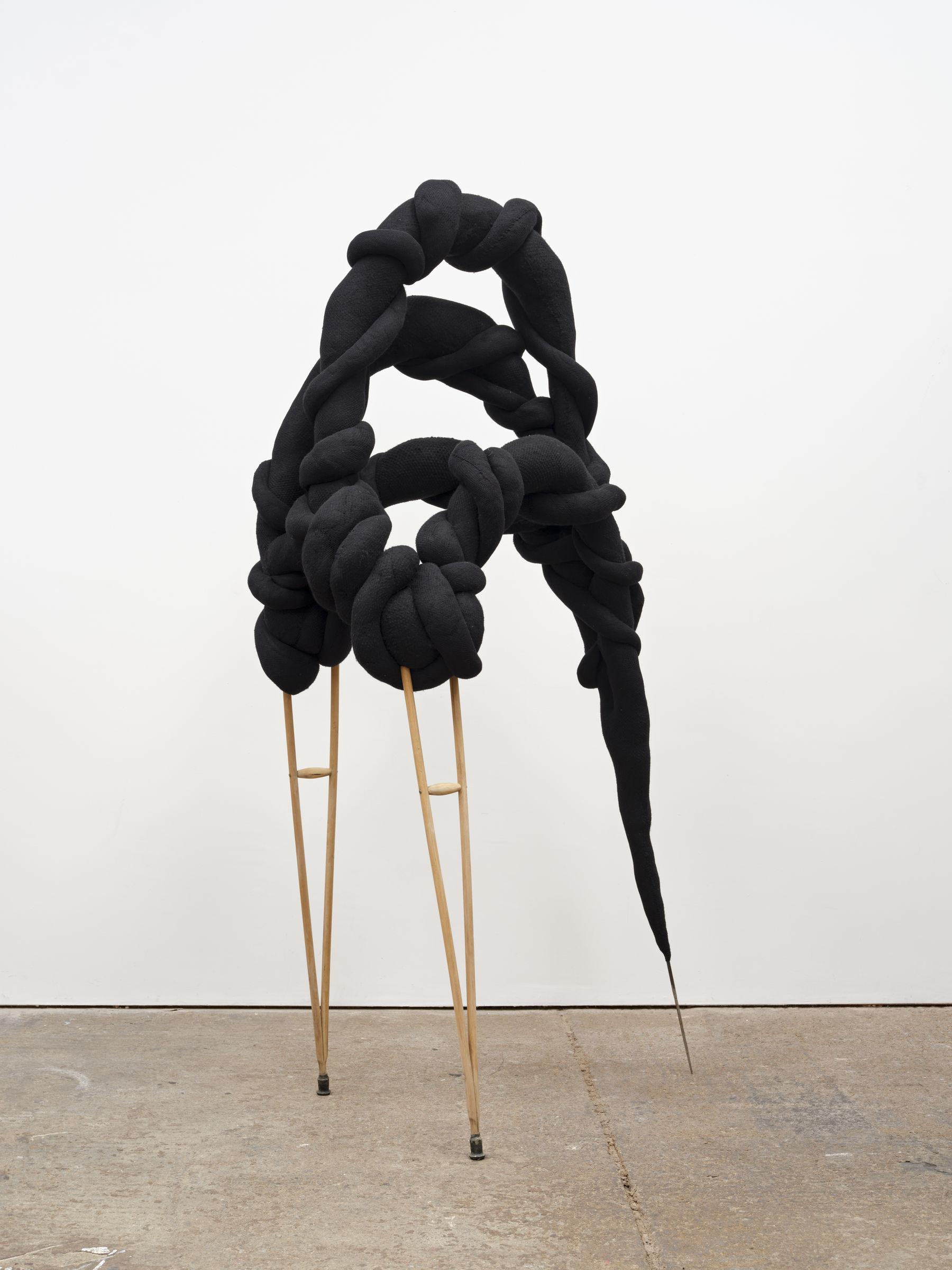
In I Tear Secrets From Your Yielding Flesh, Nicola Turner transforms wool, reclaimed horsehair and Hanover Square’s hidden histories into a persuasive, bodily sculpture installation.
At Gagosian New York, Jordan Wolfson gives circulating images physical weight, turning polished aluminium, reflection and spikes into a confrontation with screen culture.
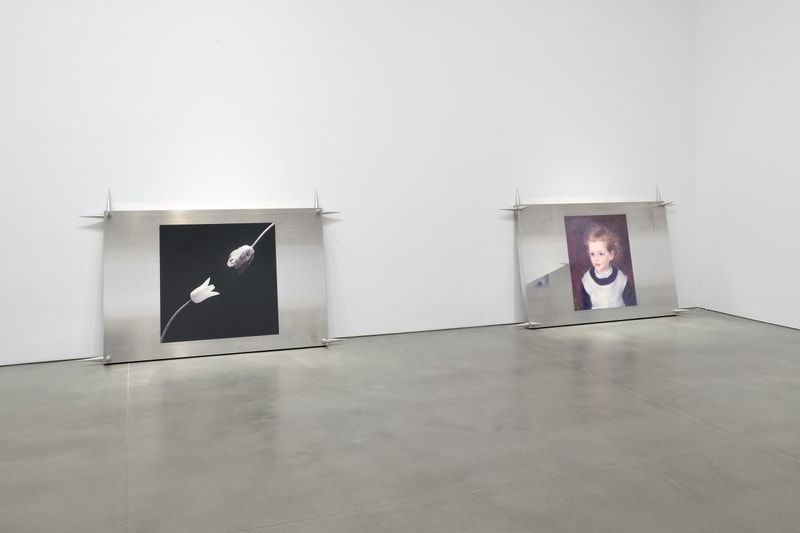
Jordan Wolfson has spent much of his career making the act of looking feel less innocent than viewers would like it to be. His animatronic figures, virtual-reality works and mechanically controlled sculptures have often made technology physically confrontational. In his first New York exhibition with Gagosian, the machinery is quieter, but the underlying pressure remains. The new works turn photographs into polished, spiked aluminium structures that occupy the gallery somewhere between image, sculpture, screen and barricade.
On view at 555 West 24th Street through 24 October, the exhibition brings together uniformly scaled sculptures incorporating colour and black-and-white photographs sourced from online, personal and academic archives. The surfaces are hand-polished aluminium, the images are printed directly onto metal, and several works project long spikes into the viewer’s space. The combination is seductive and antagonistic at once: the finish invites proximity while the form warns against it.
Installation view, Jordan Wolfson, Gagosian New York, 2026. Artwork © Jordan Wolfson. Photo: Owen Conway/Gagosian. Current exhibition image delivered via Hypebeast.
Wolfson’s central move is deceptively simple. He takes images that would normally circulate without weight—online, in archives, in reproduced photographs—and gives them a highly engineered body. The aluminium panels project from the wall. Their surfaces reflect the surrounding room. Spikes alter the safe viewing distance. What begins as photographic content becomes an architectural problem.
This shift matters in a culture where images are increasingly encountered as frictionless streams. On a phone, a photograph of a historical event, a celebrity, a flower or an AI-generated fantasy can be consumed through the same gesture. Wolfson interrupts that equivalence. He gives some images scale, scarcity, reflectivity and physical danger.

A current sculpture in Jordan Wolfson’s 2026 Gagosian New York exhibition. Artwork © Jordan Wolfson. Photo: Owen Conway/Gagosian. Image delivery via Hypebeast.
The works are deliberately close to the proportions of large screens, but they refuse the screen’s passivity. A reflected visitor can appear across the polished metal at the same time as the embedded image, making it difficult to maintain the fiction that looking happens at a distance. Wolfson turns spectatorship into part of the surface.
The exhibition draws on a deliberately heterogeneous image bank. Gagosian identifies sources from art history, popular culture and Wolfson’s own recurring preoccupations. Among the material are references to the World Trade Center and One World Trade Center, Robert Mapplethorpe flowers and other recognisable cultural imagery. Hypebeast’s report on the exhibition also notes a digitally fabricated youthful Bob Dylan and an AI-generated reworking of Jeff Koons’s Made in Heaven imagery.
What connects these references is not subject matter. It is familiarity. Each arrives with a prior life in culture, and therefore with habits of recognition already attached. Wolfson’s sculptures ask whether changing the material conditions of an image can make that familiarity unstable again.

Installation detail from Jordan Wolfson at Gagosian New York, 2026. Artwork © Jordan Wolfson. Photo: Owen Conway/Gagosian. Current exhibition image delivered via Hypebeast.
The 9/11 imagery is inevitably the most charged. Twenty-five years after the attacks, photographs of the towers exist simultaneously as historical documents, private memories and media icons repeated to the point of near abstraction. Wolfson does not treat them as documentary evidence. He places them within reflective, fabricated objects whose luxury finish and aggressive spikes make the act of recognition newly uncomfortable.
Compared with the artist’s better-known robotic works, the new exhibition can initially appear restrained. There is no programmed figure following the viewer with its eyes and no suspended puppet being dragged through a predetermined sequence. But control has not disappeared; it has changed form.
The sculptures control distance. They regulate where a visitor can safely stand. Their mirror-polished aluminium folds the viewer back into the object. Their edition structure converts infinitely reproducible source imagery into scarce physical works. Instead of choreography produced by motors and software, the choreography now takes place between object and body.
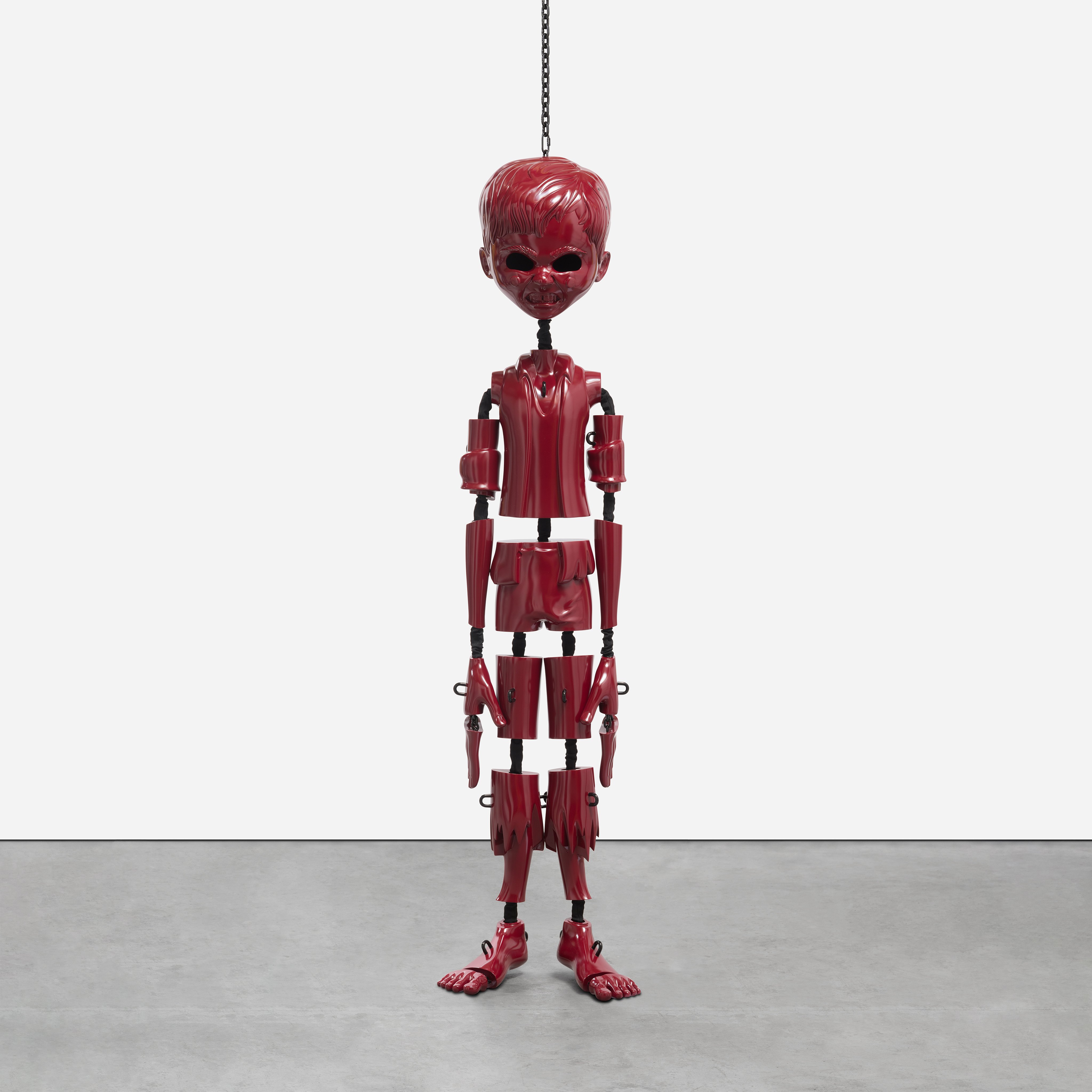
Context: Jordan Wolfson, Red Sculpture. Earlier work illustrating the artist’s longer investigation of mechanised bodies, control and viewer proximity. Courtesy Gagosian. This work is not part of the 2026 New York exhibition.
That continuity is important. Wolfson’s real subject has never been technology for its own sake. Technology is one of the means by which he tests desire, aggression, power and complicity. The new aluminium works strip away spectacle without abandoning those questions.
These sculptures should not be judged from reproduction alone. Their scale, depth, reflectivity and protruding elements are part of the work’s meaning and part of its practical reality. Installation requires substantial breathing room. Sightlines matter because neighbouring works and moving bodies enter the mirrored surface. The spikes also make circulation and handling unusually consequential.
Condition reporting should focus closely on the polished aluminium, printed image layer, automotive clearcoat, edges and spike attachments. Highly reflective surfaces reveal abrasion and handling marks immediately. A collector should also document the precise edition, artist’s proof status where applicable, fabrication details and any installation specifications supplied by the gallery.
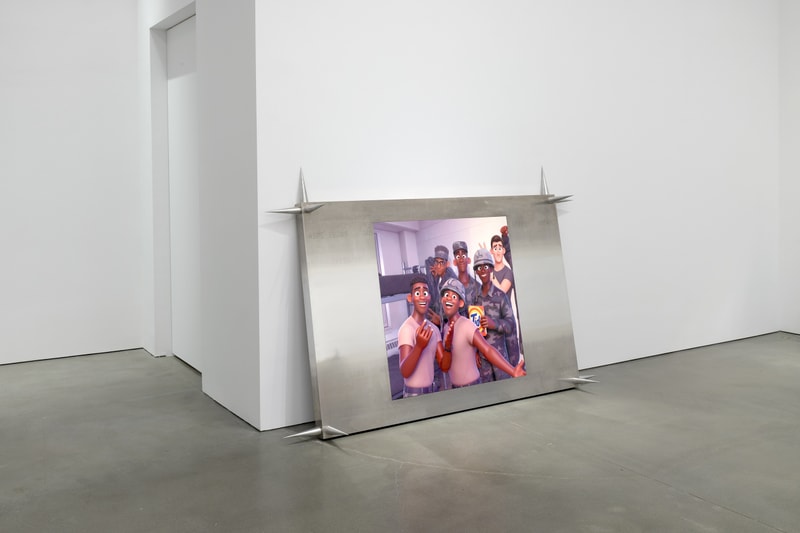
Installation view, Jordan Wolfson, Gagosian New York, 2026. Artwork © Jordan Wolfson. Photo: Owen Conway/Gagosian. Current exhibition image delivered via Hypebeast.
The strongest works in the exhibition are those in which image and structure become inseparable. If the photograph can be mentally removed without changing the sculpture, the object risks becoming an elaborate frame. When the source image gains a different psychological charge because of the metal, reflection, scale and spikes surrounding it, Wolfson’s proposition becomes harder to dismiss.
That is why this exhibition belongs in a wider conversation about contemporary image culture rather than simply in a career narrative about a provocative artist joining another major gallery programme. Wolfson asks what an image becomes after endless circulation—and whether giving it weight can restore the discomfort that repetition has worn away.
Jordan Wolfson
Gagosian, 555 West 24th Street, New York
18 September–24 October 2026.
In I Tear Secrets From Your Yielding Flesh, Nicola Turner transforms wool, reclaimed horsehair and Hanover Square’s hidden histories into a persuasive, bodily sculpture installation.
At Gagosian New York, Jordan Wolfson gives circulating images physical weight, turning polished aluminium, reflection and spikes into a confrontation with screen culture.
Christie’s reveals the late Clive Davis’s private collection, from Warhol and Hockney to Stella and Mitchell—and the discerning eye behind a lifetime of collecting.