Alix Vernet sees the backs of New York air conditioners as archives: fragile aluminum surfaces that record weather, maintenance, touch and heat exchange. LANDMARKS turns overlooked infrastructure into some of the city’s strangest new monuments.
Paris Design Week 2026: The Collector’s Edit
Paris Design Week is too large for a checklist. Our collector’s edit focuses on the places where collectible design, exceptional craft and historic interiors create the strongest opportunities for serious looking and collecting.

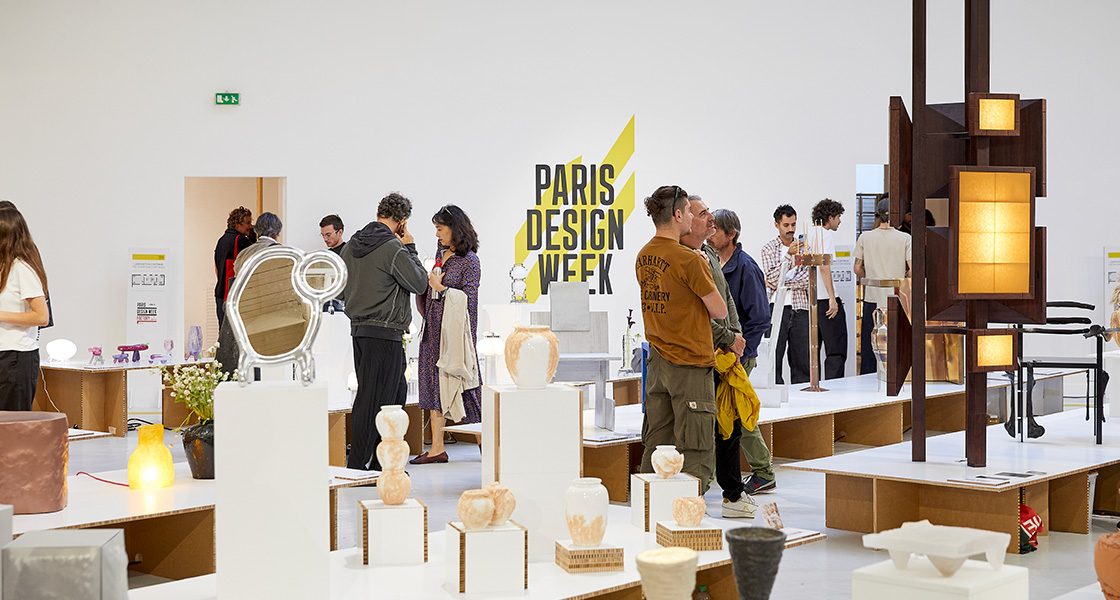
Paris Design Week is too large to be consumed sensibly as a checklist. Running from 10 to 19 September 2026, the city-wide programme brings together around 500 participants across 320 venues, from galleries and showrooms to museums, historic monuments, studios and temporary installations. The useful question for collectors is therefore not how to see everything. It is where the week becomes more than a launch calendar and begins to reveal objects, makers and ideas capable of lasting beyond September.
This year, the strongest route runs through precisely the territory ARTCOLLECTORHOMES is interested in: collectible design presented inside historic architecture; furniture treated as sculpture; craft understood as contemporary authorship; and emerging makers encountered before consensus has formed around them.
What follows is not a ranking. It is a collector’s edit — the places where context, material quality and authorship are doing the most interesting work.

Joseph Walsh at the Hôtel de Sully: start with the object and the building
The most compelling stop is Joseph Walsh’s Arcanum Formae at the Hôtel de Sully. The seventeenth-century hôtel particulier is already one of the Marais’s most elegant architectural experiences, structured around stone façades, courtyard, garden and orangery. Walsh inserts monumental organic ash sculptures into that geometry rather than treating the monument as a neutral backdrop.
The opposition is productive. Walsh’s work appears to bend, loop and grow; the Hôtel de Sully depends on proportion, axis and classical order. The designer has described the project in terms of confronting free movement with perfect geometry, and the installation gives that idea physical force. His Gestures and Enignum works seem less placed in the architecture than temporarily released inside it.
For collectors, Walsh is a useful example of why the best collectible design increasingly sits comfortably beside contemporary sculpture. Function may remain somewhere in the ancestry of the object, but its value resides in material intelligence, scale, authorship and the extraordinary degree of making required to produce a form that appears effortless.
Arcanum Formae runs beyond the official design week, through 25 October, which also allows the work to be seen after the opening-week crowds have passed.

Anthony Guerrée at Musée Bourdelle: design learns from sculpture
At Musée Bourdelle, Anthony Guerrée’s Contrepoint offers one of the week’s most intelligent dialogues between contemporary design and historical art. Rather than filling the museum with autonomous new products, Guerrée has looked directly at Antoine Bourdelle’s sculptural vocabulary and translated lines, curves and tensions into furniture, screens, textiles and terracotta.
Four stained-glass and ash-wood screens occupy the great plaster hall, where coloured light moves around Bourdelle’s monumental figures. Elsewhere, mixed-clay and terracotta experiments are presented with moulds and matrices, making process visible rather than hiding it behind the finished object. The Orbe chaise longue appears in a specially developed jacquard inspired by forms in Bourdelle’s sculpture, while smaller pieces include a unique rotating bookcase.
The exhibition is especially relevant to collectors because it refuses the familiar separation between “decorative” and “serious” objects. A screen can organise a room and still be an autonomous artistic proposition. A chaise longue can be useful while carrying a specific relationship to sculpture, textile history and craft. The best pieces here gain meaning from use rather than being diminished by it.

Why the material story matters
Contrepoint is also a reminder that collectible design should be judged through the chain of making. Guerrée’s stained glass is realised with Sophie Toporkoff; the ash structures involve the expertise of woodworker Louis Monier; terracotta research has been developed with Fornace Brioni; the bespoke jacquard draws on Tissages de Charlieu. The finished work carries several traditions without looking like a craft demonstration.
That is useful collector intelligence. When looking at contemporary furniture and objects, authorship is important, but so is the quality of the ecosystem around the designer: who fabricates, what processes are proprietary or unusually difficult, whether materials have been developed specifically for a project, and how much of the work could genuinely be replicated without that network of knowledge.
Paris Design Week is at its best when it makes those questions visible.
Factory: where collectors should look before the market agrees
The Paris Design Week Factory programme remains one of the most valuable parts of the week for anyone willing to look early. Running from 10 to 14 September, the 2026 edition brings together more than 130 emerging designers across thematic presentations devoted to collectible design, editions, craft and international work in the Marais.
It would be a mistake to approach Factory expecting every prototype to become a future classic. Its value lies precisely in the absence of certainty. The collector can compare how young practices solve familiar problems — seating, lighting, vessel, surface, storage — before gallery representation and secondary-market narratives begin to stabilise reputations.
At this stage, questions of edition size, fabrication and documentation become particularly important. Is a piece a one-off prototype, an artist proof, an open edition or the beginning of a numbered series? Will future examples be materially identical? Is the maker producing in-house or outsourcing? Does the work come with a certificate and clear material specifications? Early collecting is most rewarding when enthusiasm is paired with unusually good record-keeping.

The city itself is part of the exhibition
One reason Paris Design Week can outperform a conventional design fair is that the city supplies contexts a temporary booth cannot. This year’s expanded routes continue to bring visitors into showrooms, apartments and heritage sites where objects can be judged at domestic scale.
The new emphasis on private-style apartment settings is especially relevant to ARTCOLLECTORHOMES. Collectible design changes when it is seen beside books, textiles, art and architecture rather than isolated under exhibition lighting. Scale becomes easier to judge. A chair reveals whether it dominates a room or completes one. A sculptural lamp begins to make sense as a source of atmosphere rather than as a silhouette photographed against white.
For collectors building homes rather than storage inventories, that difference is substantial. The most expensive object is not necessarily the one that creates the strongest interior. Paris offers repeated proof that relationships between objects matter as much as individual signatures.
Hôtel de la Marine and the return of exceptional craft
The Hôtel de la Marine is another important stop because its programme situates contemporary making inside one of Paris’s most intensely decorative historic environments. Projects around glass, porcelain, wood, feathers, paper and other métiers d’art are especially effective here because the building refuses the false idea that ornament is somehow incompatible with intellectual seriousness.
That context helps explain a wider shift in collecting. The old hierarchy that placed painting and sculpture at the top, furniture somewhere below and decorative arts further down has become increasingly difficult to maintain. Collectors now move more freely between a unique cabinet, a ceramic sculpture, a work on paper, a historic textile and a contemporary painting when the quality justifies it.
Paris Design Week is not causing that change, but it is one of the places where the new collecting behaviour is easiest to see.

How to collect the week rather than merely visit it
The best strategy is to edit aggressively. Begin with makers whose work changes when seen in person: complex surfaces, unusual joinery, glass, ceramics, carved wood, cast metal and textiles rarely reveal themselves fully on a screen. Ask galleries and designers about edition structure and fabrication before discussing future value. Photograph labels and retain price lists. Record the exact version, finish and dimensions of anything under serious consideration.
For established names such as Joseph Walsh, provenance and the relationship of a work to a recognised series matter. For emerging designers at Factory, the questions are different: originality, technical command, consistency and whether the practice appears capable of developing beyond a single photogenic object.
Most importantly, resist the pressure to buy simply because something is new. Design weeks reward speed, but good collections reward memory. The piece worth acquiring is usually the one that remains vivid after the visual noise of hundreds of launches has fallen away.
The collector’s Paris
The strongest Paris Design Week 2026 presentations share an interest in objects that carry their making visibly. Walsh bends timber until structure becomes gesture. Guerrée translates sculpture into glass, wood, clay and textile. Factory exposes practices before they have been tidied into mature brands. Historic Parisian interiors provide the friction that makes contemporary pieces easier to judge.
That is the week’s real attraction for collectors. Paris does not ask design to become art by imitating a gallery. It shows how design can earn equal seriousness through material, authorship and the way an exceptional object changes the space around it.
Paris Design Week 2026 runs from 10–19 September across Paris.
Paris Design Week Factory runs 10–14 September. Anthony Guerrée’s Contrepoint is at Musée Bourdelle through 27 September, while Joseph Walsh’s Arcanum Formae continues at the Hôtel de Sully through 25 October.
Paris Design Week is too large for a checklist. Our collector’s edit focuses on the places where collectible design, exceptional craft and historic interiors create the strongest opportunities for serious looking and collecting.
A floating zeppelin, mother-of-pearl surfaces and futuristic ruins make Lee Bul’s first Hauser & Wirth New York exhibition one of September’s strongest shows — and a timely moment to reassess a four-decade practice.