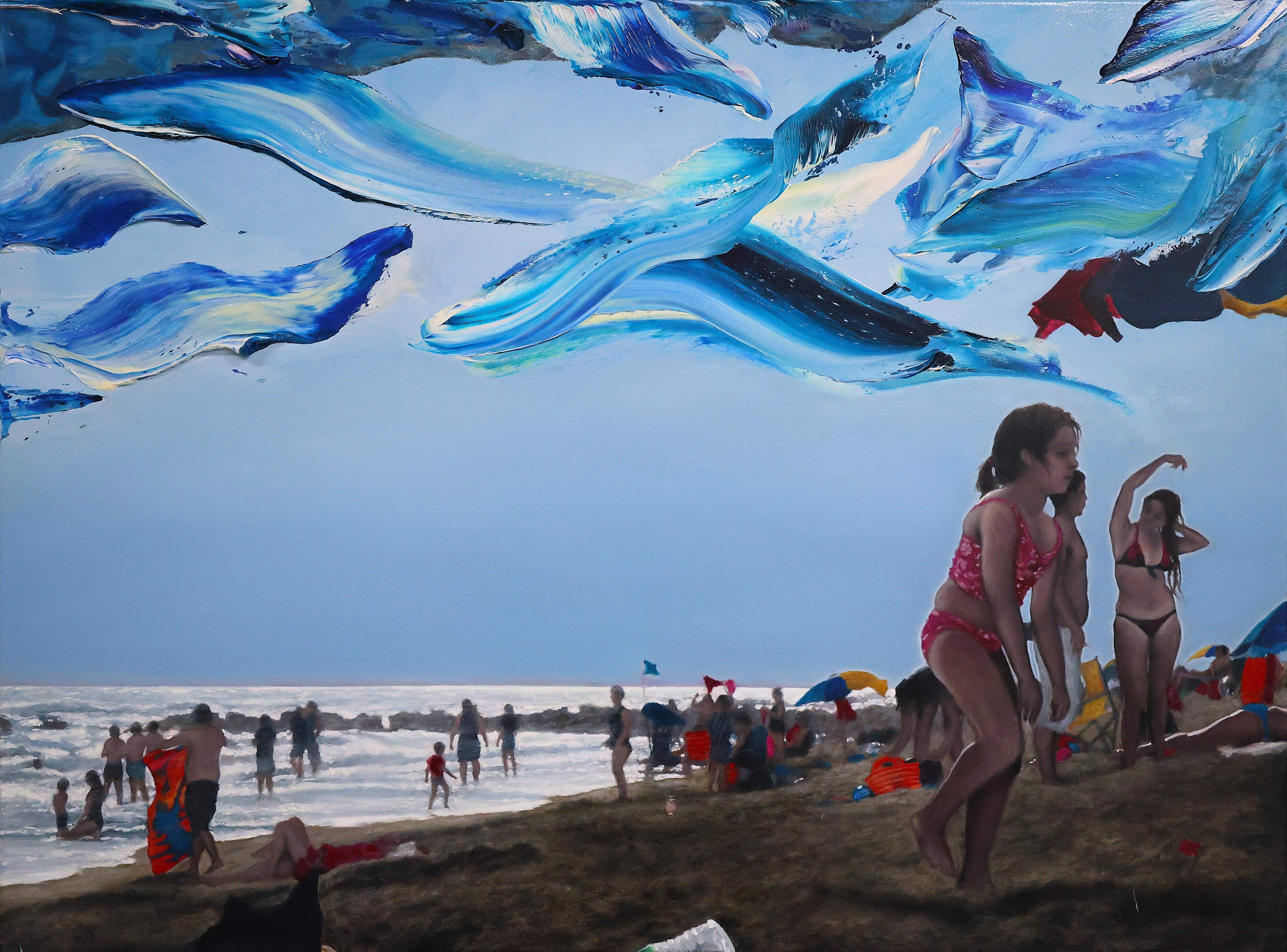
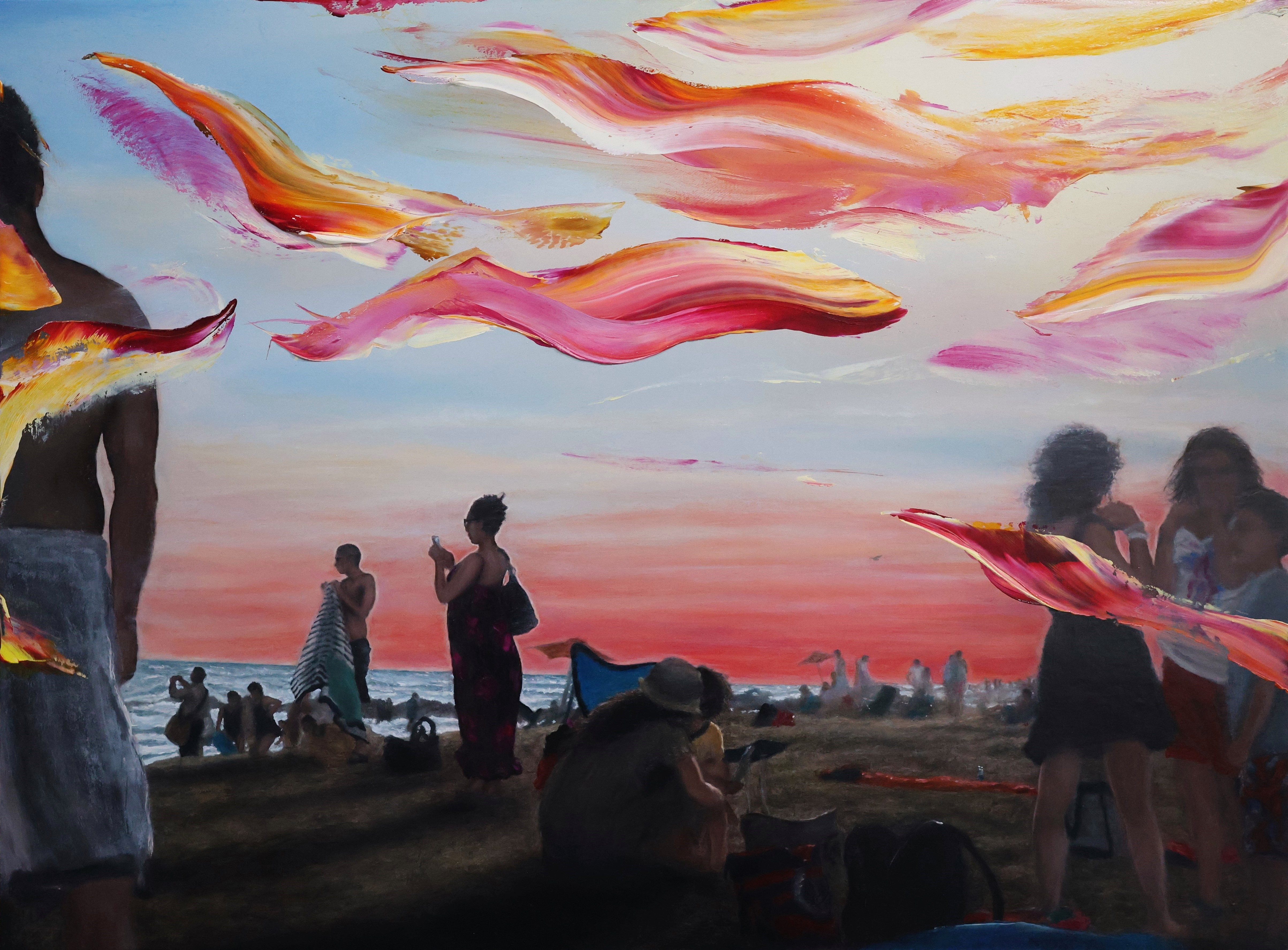
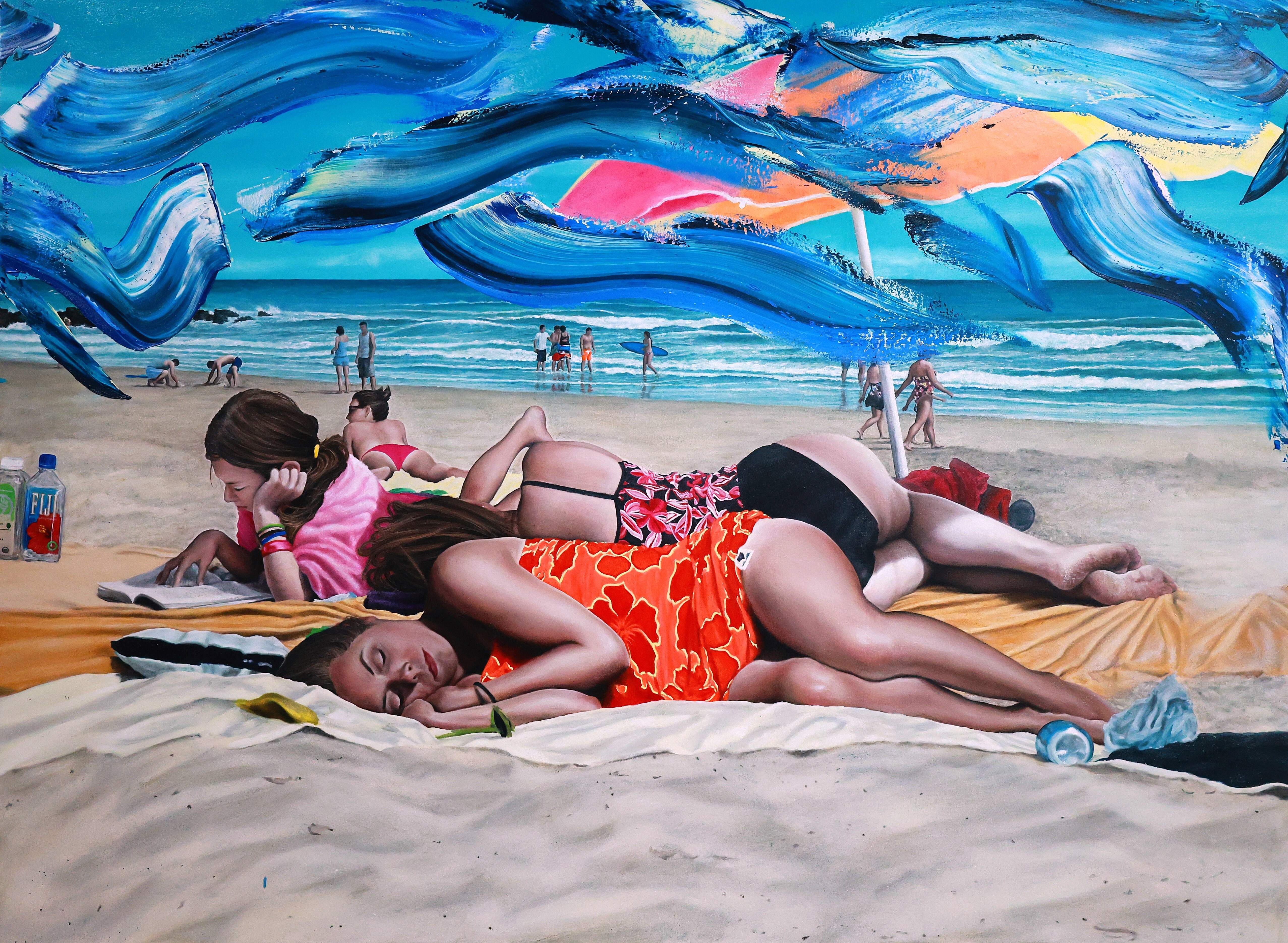
Three years after ARTCOLLECTORNEWS first spoke with Maxwell Stevens about Last Days of Summer, the New York painter has returned to the beach. But in Surfside, the setting has become less a backdrop than a social and psychological stage. The new paintings bring swimmers, surfers, couples, families and groups of friends into close proximity along the North Atlantic coast of Long Island. Stevens renders these figures with an almost portrait-like concentration before disrupting them with broad smears, calligraphic strokes, impasto and flashes of cobalt, turquoise and aqua.
Maxwell Stevens: Surfside — Time, Leisure and the Social Theatre of the Beach
Three years after ARTCOLLECTORNEWS first spoke with Maxwell Stevens about Last Days of Summer, the New York painter has returned to the beach. But in Surfside, the setting has become less a backdrop than a social and psychological stage. The new paintings bring swimmers, surfers, couples, families and groups of friends into close proximity along the North Atlantic coast of Long Island. Stevens renders these figures with an almost portrait-like concentration before disrupting them with broad smears, calligraphic strokes, impasto and flashes of cobalt, turquoise and aqua.
-p-500.jpg)
Three years after ARTCOLLECTORNEWS first spoke with Maxwell Stevens about Last Days of Summer, the New York painter has returned to the beach. But in Surfside, the setting has become less a backdrop than a social and psychological stage. The new paintings bring swimmers, surfers, couples, families and groups of friends into close proximity along the North Atlantic coast of Long Island. Stevens renders these figures with an almost portrait-like concentration before disrupting them with broad smears, calligraphic strokes, impasto and flashes of cobalt, turquoise and aqua.
The new paintings seem to push much further into questions of leisure, social behaviour, isolation, time, memory, perception and the relationship between abstraction and figuration. The beach now feels less like a setting and more like a kind of social theatre: people are physically close, exposed and relaxed, yet often psychologically separate, while the abstract gestures begin to interrupt, erode and destabilise the realism beneath them.
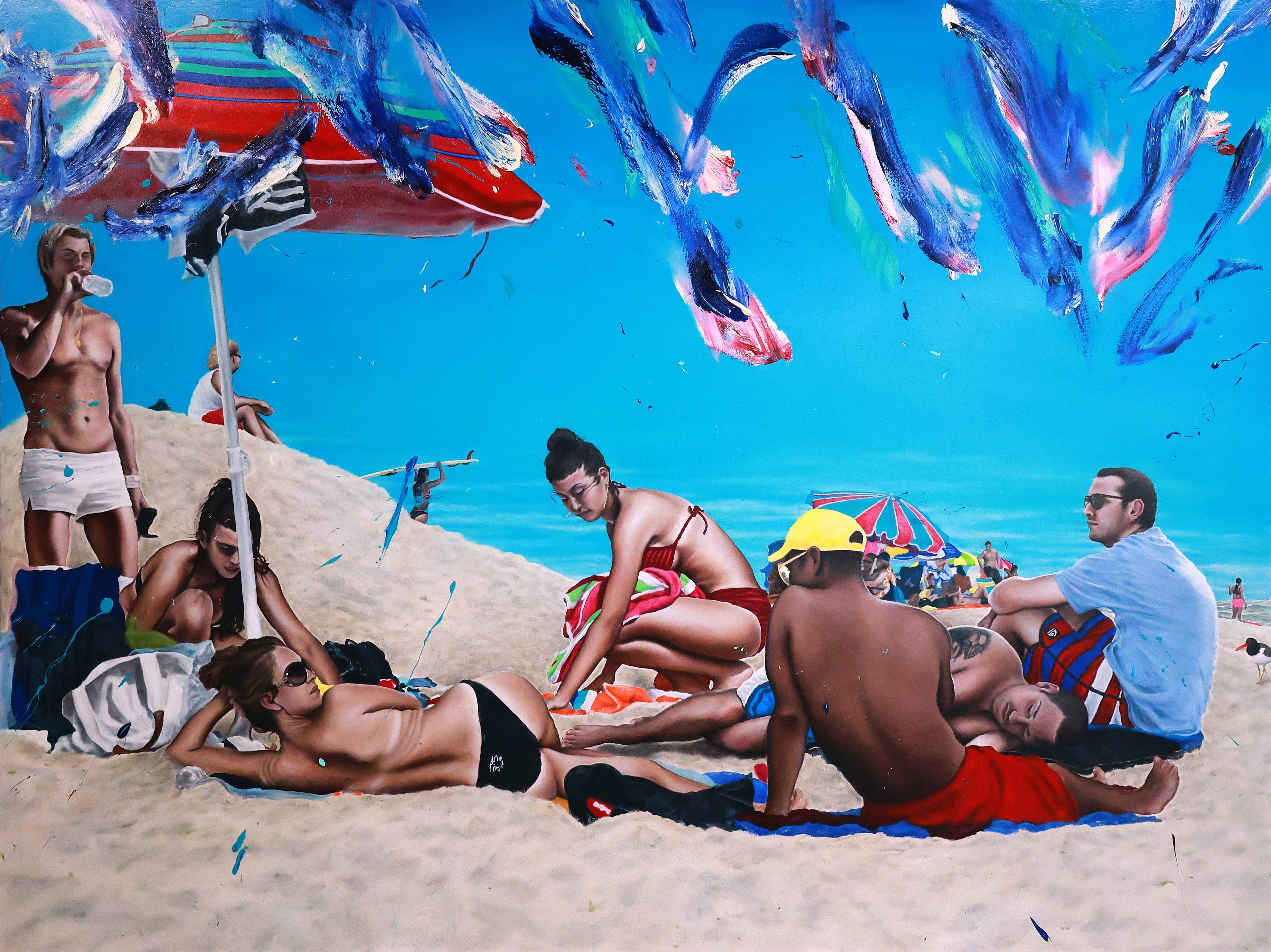
In the large central painting Surfside, a loosely connected group occupies the sand beneath a sky fractured by enormous gestures of paint. Some figures converse; others look away or withdraw into themselves. They are physically close but psychologically separate. What initially resembles an ordinary summer scene gradually becomes something stranger: a study of leisure, desire, observation and the peculiar isolation possible even within a crowded public space.
Elsewhere, the series shifts between monumentality and transience. Figures take on the gravity of statuary, while abrasion, overpainting and fragmentation make them appear vulnerable to time itself. In other works, the image softens toward mirage, hovering between recognition and pure colour.
Taken together, Surfside feels less concerned with simply depicting the beach than with what the beach reveals: how people behave when ordinary social structures loosen, how memory alters perception, and how painting can hold several kinds of time at once. With that in mind, these are the questions I’d love to explore with you:
ARTCOLLECTORNEWS: When we spoke about Last Days of Summer, the beach already carried ideas of memory, pleasure and impermanence. In Surfside, the same environment feels more psychologically complicated. What changed in your understanding of the subject between the two series?
The paintings in the Surfside series comprise the apex of this summertime theme. Specifically with this newer selection of paintings, I decided to slow down and focus on the aspect of portraiture within each scene, and in some ways my goal was to circumvent the leisurely subject matter to see if it was possible to communicate more intimately our psychological complexities within the context of the beach. It’s a setting where the viewer expects a certain kind of celebratory atmosphere but not usually where they engage subjects that are more deeply personal or introspective. As an expansion on my previous series of beach paintings, I also wanted to round out the subject to include moments where things maybe aren’t quite as lighthearted, people in these works are still relaxing, but they seem to have brought some of their burdens with them, which is oftentimes what we see.
ARTCOLLECTORNEWS: Looking at the large Surfside painting, what strikes me is how physically close everyone is while many of the figures seem to inhabit completely separate mental spaces. Is that tension between togetherness and isolation becoming more important in the new work?
I’m glad you noticed that. This aspect of social isolation in the newer paintings wasn’t entirely intentional and became clearer once the paintings were completed as a cycle. And I think it occurred through the act of painting itself. One of the things I set out to do with the new paintings was to spend more time on the subtle emotional nuances that we often observe in others, and in doing so, this seemed to individualize each person in the group, setting them apart from one another. In the central painting Surfside, there’s a sexual dynamic among this group of young people but it’s not entirely clear who knows each other and who has just walked up and joined their circle. This introduced an element of tension to an otherwise totally relaxed scene. Also, it was only after scrutinizing their faces more clearly that I realized everyone seemed to be glancing at someone else without reciprocating the other person’s gaze, so there is this cycle where one person is watching another who is looking at another and so on, culminating in the athletic male who is sort of standing over the others and looking at someone beyond the group, possibly towards the viewer. I initially painted his glance to be staring directly at the viewer and then shifted it slightly away, so it now continues this disconnected cycle.
ARTCOLLECTORNEWS: The beach is an unusual public space. People remove much of the clothing and social armour they normally carry, lie beside strangers, expose their bodies and spend hours doing very little. What does that temporary relaxation of ordinary social rules reveal to you about people?
Isn’t it great spending hours doing very little! The beach is a place for people to let go, especially in New York where the summer season only lasts for 3 months or so, and everyone is hustling through the other seasons, and the winters can be harsh and brutal. So they let go, and there is this collective aspect of fun-loving people enjoying being in the company of others, in close proximity to strangers with their bodies completely exposed, that is at total odds with how we carry ourselves in our daily lives. I think there are shared aspects of the human condition that bring us together into communal spaces which transcend any divisive conditions in society. Leisure allows for this and these natural spaces along the shoreline are where people of all walks of life can interact in uninhibited ways. I’m also intrigued by the mutually voyeuristic aspects of the beach, where everyone is simultaneously people watching and on display themselves. And there’s this group energy, like a huge party really, that includes people of all age groups and walks of life. This is something that I think is unique to the social spaces such as public parks and beaches in New York.
ARTCOLLECTORNEWS: You have described the ocean as a place where you can experience youth, nature and interpersonal dynamics in an intimate and carefree way while also reflecting on the transience of life. That combination of pleasure and mortality seems fundamental to these paintings. Can leisure itself become existential for you?
This seeming contradiction might actually be what draws me to painting these leisurely subjects, because they seem so contrary to the reality of the world at times. The fact of our mortality, we escape this temporarily, through leisure and pleasure, but it’s always there of course. People go to the shore to relieve the pressures of life, to get lost in a good book and spend quality time with friends and family, swim in the ocean. Over time, this subject matter has presented an entire world in itself, with an array of shared moments from ecstasy and pleasure to quieter, reflective, even melancholic moments, and I would like this entire range of emotions to come across to the viewer through both the scenes depicted and also the direct emotional connection we have to abstraction as an extension of nature itself.
ARTCOLLECTORNEWS: In Surfside, the figures almost form a contemporary frieze across the sand. A reclining body can suddenly feel sculptural, while another figure under an umbrella assumes the presence of a portrait. Are you consciously elevating these ordinary beach gestures into something more monumental or allegorical?
I really like your comment about forming a contemporary frieze because in some ways I think that is exactly what it becomes, some individuals appear almost like living statues. And others I observe at the beach, their poses and behavior seem monumental to me, even heroic. Whether it’s the statuesque posture of an athletic female surfer standing directly over me as I’m relaxing with a margarita in the sand or an intense gaze between two beachgoers that recalls a composition of lovers by Titian, I’m completely fascinated by how these ordinary moments often remind me of great art. I’m not consciously an allegorical painter at all, but this real moment of a solitary lifeguard walking home seemed to evoke symbolic meaning beyond the image. With his straw hat and arm extended he even reminded me of Van Gogh’s The Sower at Sunset, which is indeed a highly allegorical work. I think there can be unintentional allegorical undertones in everyday scenarios, associations that are made during the painting process that can imbue a particular artwork greater significance.

ARTCOLLECTORNEWS: Some of the figures, particularly the surfers, can take on an almost heroic or mythological quality. How much do ideas of classical sculpture, ancient statuary or older traditions of figuration enter your thinking when you paint contemporary people?
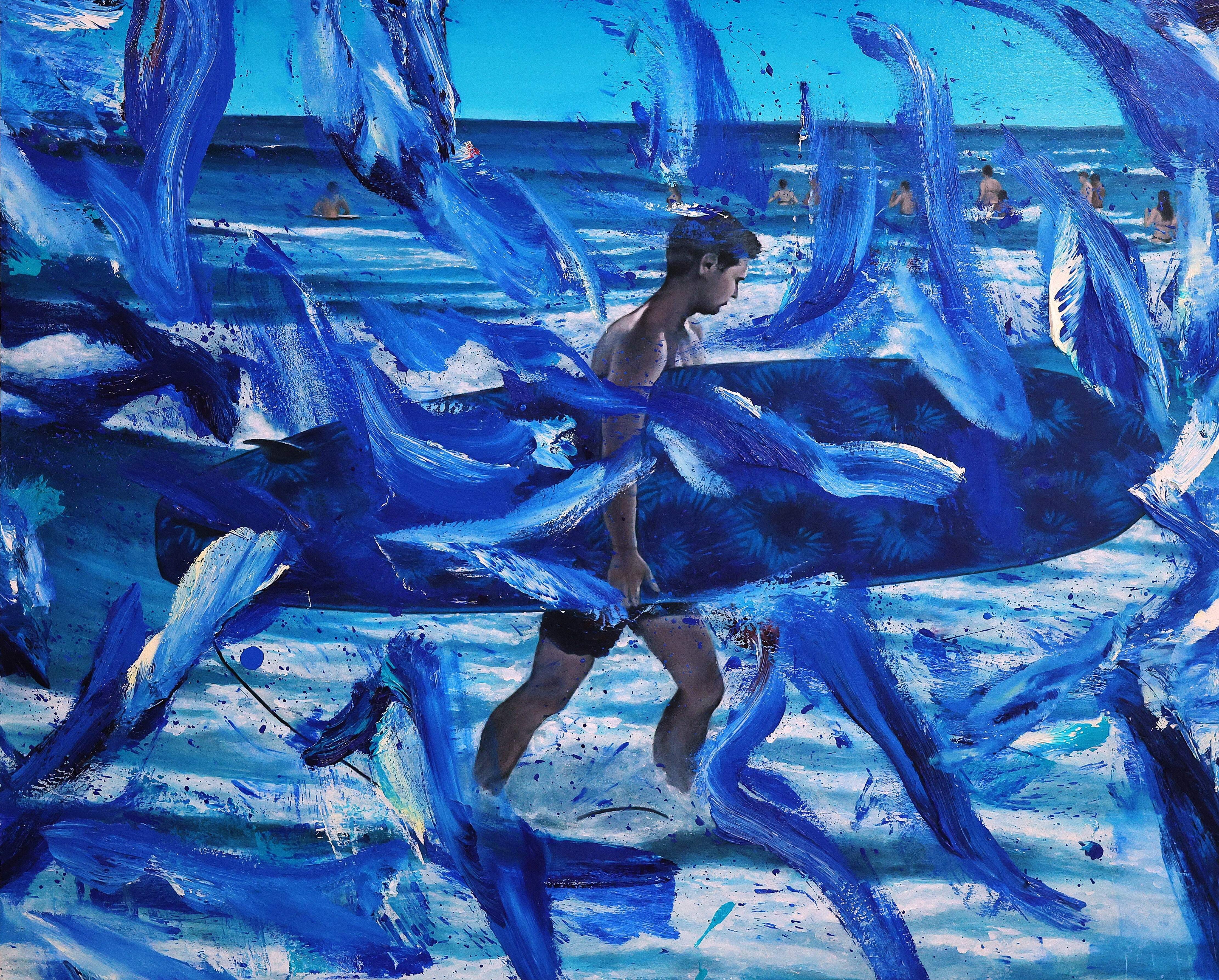
In the painting Blue Surfer for instance, I was actually thinking of something heroic and mythological. There is an aspect about his downcast gaze and the way he was struggling through the waves that seemed like he was going off to battle, and this particular painting was a battle to resolve, with some things going on in my life that weren’t so pleasant and I ended up having to pull it off the wall , scrape it out and rework the composition entirely a couple of times before it fell into place. The abstract overpainting here really is a lot grittier and seemed to express his interior mood. It’s the most recent work in the series and is now one of my favorites. I was talking about it with a couple of friends and this one I now actually do think of as a sort of self-portrait or an allegory of the solitary artist in society.
A lot of the art I look at now is from ancient cultures, even though my painting practice is entirely centered in our own era. Particularly time-worn frescoes, damaged sculptures, forms that are at once beautiful but affected by time. I’m particularly fascinated by how the mind fills in the missing areas when presented with a fragment of a mural for instance, or a partial bust, our imagination lights up. And for me the abstract overpainting, especially where it partially obscures and fragments the figure, but also in how it affects the image, is a way of facilitating this as a visual metaphor for the relentless aspects of outside forces upon our lives, bodies, and spaces we occupy.

ARTCOLLECTORNEWS: There is an interesting collision between that sense of monumentality and the fact that these moments are completely temporary. Someone changes position, an umbrella moves, the tide advances. Is painting partly a way of giving permanence to things that are inherently disappearing?
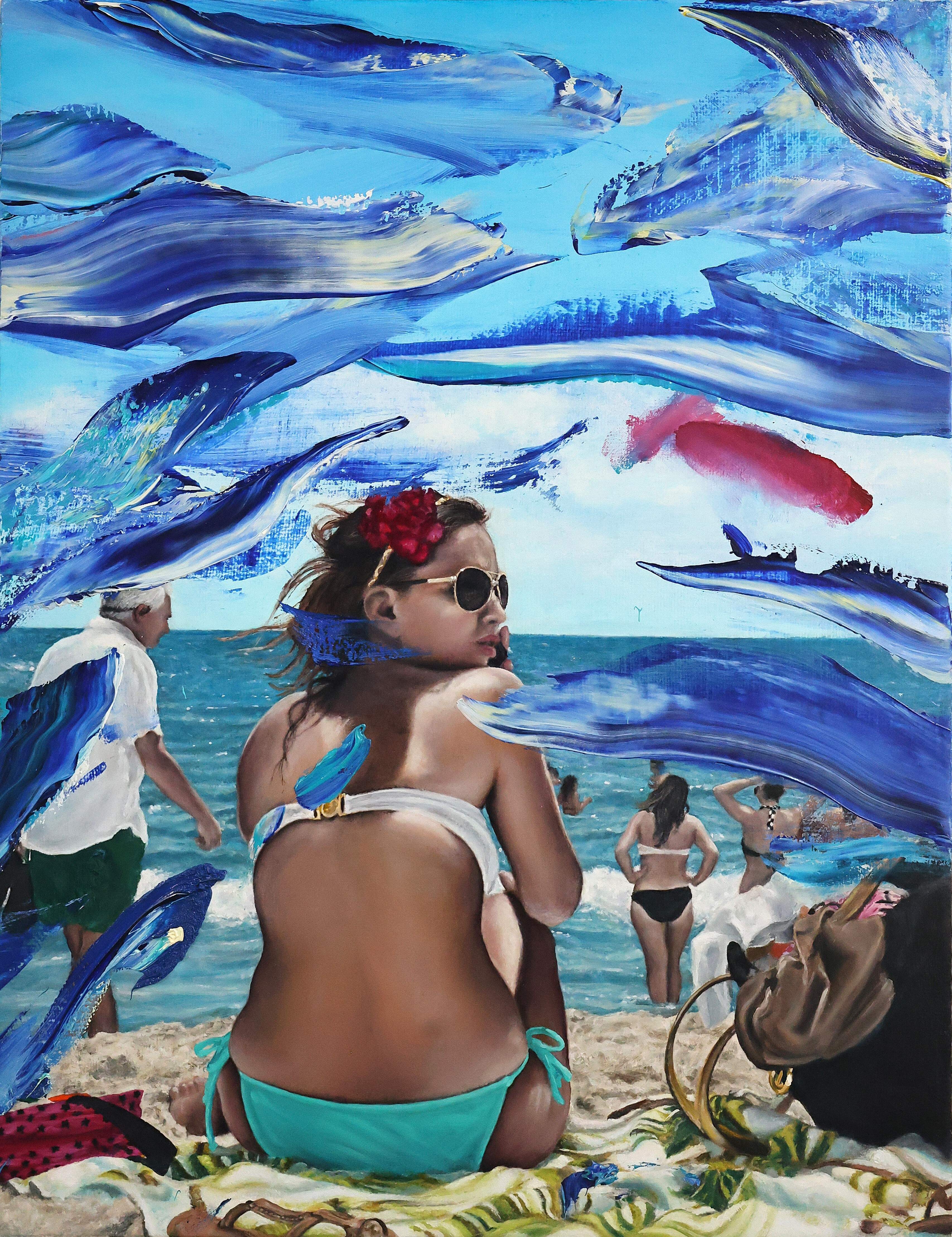
The small portrait Beach Girl, Surfside, where she is seen from behind with a flower in her hair and she has just slightly turned her head is a good example of a disappearing moment. It was a beautiful instant that within a few seconds was gone forever, but painting is very adept at taking fleeting moments and making them eternally present. I appreciate the term you use here, “collision” because it very accurately describes both the relationship between monumentality and the ephemerality of these disappearing moments, as well as the abrupt convergence between abstraction and figuration in the paintings. The abstractions themselves are executed in a much more rapid, fleeting timespan than the images beneath, so these moments in the studio mirror those on the beach in a way. But importantly, when we go through our daily lives we encounter so much visually around us, even in a single day, just filled with fleeting moments, over weeks, months and years, we forget almost all of these. But a few stay with us, and it doesn’t necessarily have to be a life-changing event. Sometimes it’s just a vivid memory or a moment shared with others. These disappearing moments are monumental in a way, because they have become a core part of your being here on earth and they inform who we are.
ARTCOLLECTORNEWS: You have mentioned the difference between chronological time and what you call “manifest time.” What does manifest time mean to you, and how does a painting allow you to experience time differently from the instant captured by a photograph?
“Manifest time” is just another term I was using for psychological time, the way we actually experience the flow of time in our lives, its elasticity, as opposed to chronological time which is usually considered to be factual time. And our experience of time, as we all know, tends to speed up when we’re enjoying ourselves at the beach or having drinks with friends, for instance, and seems to slow down when we’re waiting on a train, sitting at the dentist’s office, and so on. In painting, time fluctuates a lot, from going by very fast and it also slows way down, or seems to, in the studio and even when looking at pictures in a gallery or museum. To me, time has a plasticity of its own—not merely in how we perceive it, but in how it seems to expand, compress, and deepen through the acts of making and viewing art. Author and theoretical physicist Jim Al-Khalili has recently been discussing how “manifest time” needs to be considered as seriously as chronological time for us to have a truly comprehensive understanding of time, and I think our experiences with visual art can make a significant contribution to this conversation.
ARTCOLLECTORNEWS: Does that make the painting a kind of time capsule? It contains the moment you observed, your memory of it, the source image, the time spent painting it and then the viewer’s own present moment all at once.
In some ways, probably all art across cultures is a sort of time capsule. But painting has a way of entering into singular moments differently, and quite effectively. Any given photo we take today is a single moment, and no medium can compare with its efficiency. In painting though, our perception of time, and our experience of time changes, and I’m more intrigued by how a single moment can hold so much significance in a work of art with all the time invested in its creation. Painting has a way of bringing past moments into the present, and lending fleeting memories a significance they otherwise do not have, and each image becomes a time capsule that isn’t simply a record of my own perceptions at the beach for instance, but of summertime as it’s experienced in our own era collectively, the objects, apparel, hair styles, beverages, that we see around us today and that adorn our reality. Plastic water bottles may not exist in 20 years, our cell phones will seem antiquated by the next decade, styles change. And unlike photographs, I see paintings as more than records of isolated moments; the hours spent making them become embedded in the work itself, turning each piece into a vessel of time. That accumulated presence gives visual art a particular vitality. Although every painting preserves its own moment, it is also connected to others through its origins, subject matter, visual language, and style. In this sense, each artwork becomes a kind of time capsule.
ARTCOLLECTORNEWS: The abstract strokes seem more forceful in these paintings. In Surfside, they occupy the sky almost like another event taking place above the figures; in other works they cut directly across bodies or become abrasive and melancholic. Do you decide what those gestures mean before they are painted, or does their emotional character emerge through the act of painting?
They do seem more forceful and felt more decisive, but what you’re describing isn’t completely intentional and does indeed emerge through the painting process itself. I’ll make certain decisions beforehand regarding the brushes I'm going to use for a particular overpainting and the colors I’m mixing on my palette, and these affect the emotional character of the work, for instance the long handled brushes allowed for scattered marks like an event or explosion of energy over the people in the painting Surfside, and scrapers and trowels will create a harsher visual effect than my smearing tools which produce a cleaner, glassy quality as in Summer Daydream. But the process is always open to change and sometimes the reworking of brushstrokes as in Blue Surfer take an otherwise brightly sunlit daytime scene and imbues that with a grittier, darker feel that literally emerges out of being dissatisfied with the initial composition and reworking it entirely.
ARTCOLLECTORNEWS: The press material describes your abstraction as a kind of “door to the unknown.” Is that important because a highly rendered figurative image risks explaining too much, while abstraction restores uncertainty?
It definitely does that, I mean, I’m not in full control of how these paintings work out and there is a high degree of risk involved that means that some of the works do not turn out well and I then proceed to scrape them down, rework them, or move on. When I set out to paint a realistic image, I’m more certain of what I am presenting and describing, and it sets the stage for the viewer, but abstraction is inherently unknown, especially in this context. How the abstraction will affect the image, fragment the picture, reshape it in new ways, and what sorts of new relationships emerge, what emotions it elicits from this fusion comes out of the painting itself. I’m certain about when a painting turns out well, but much less so about its actual meaning at that point, and from an artistic standpoint, I would much rather be standing in front of a mystery in my studio than a formulaic product. And while the scenes themselves are often open to interpretation and relatable to each viewer’s own experiences, the abstractions present a more mercurial openness that elicits a wider range of interpretations and relationships based on the viewer’s own nuanced emotions and mindset, so the paintings are always changing in terms of their meaning, they never seem fixed.
ARTCOLLECTORNEWS: I’m particularly interested in what happens perceptually when a convincing illusion of a body is suddenly interrupted by an unmistakable smear of oil paint. For a moment we stop seeing “a woman” or “a surfer” and simply see colour and matter. Are you deliberately trying to make the viewer move back and forth between image and paint?
When you say we stop seeing a woman or a surfer, that to me is crucial. Art is one of the only ways for us to look at the world differently, and that perceptual delay in recognizing figures, forms and images we are familiar with often initiates visual or semantic indeterminacy as well, allowing space to consider what we are observing differently than we otherwise would. Descriptively, we can all agree on the initial subject of the paintings by the scenery, but abstraction introduces a Rorschach-like aspect to the images that is highly subjective and totally open to interpretation, and is largely defined by the viewer. So yes, I am deliberately moving back and forth between image and paint, partly because the improvisational aspect allows the paintings to explore areas I don’t fully control, and I step back and wonder about it myself. In so doing, I want to facilitate the imagination of the viewer in constructive ways that are liberating for them as well. The viewers’ interpretation of these works is more personally defined than it might be with a straightforward depiction or a pure abstraction, and differs from mine or that of anyone else. And I don’t decide finally on the meaning of these works, the viewer does.
ARTCOLLECTORNEWS: Gestural abstraction also carries a considerable history of its own. A broad spontaneous brushstroke inevitably recalls generations of abstract painting. What happens when you take that historically autonomous language and place it directly over a photographic or figurative image?
It recontextualizes it entirely. What might otherwise be seen as an abstract brushstroke becomes something else. The abstraction actually takes on a functional aspect that doesn’t exist in a purely abstract painting, and the figurative work yields to its own destruction and fragmentation that gives it an alternate meaning. By overpainting these images with gestural abstraction, I want to recontextualize both the language of abstraction and the representational imagery beneath it in new ways.
ARTCOLLECTORNEWS: And does the reverse happen too? Does the image underneath alter the supposedly free gesture, so that a blue stroke crossing water, skin or sky can no longer be read as purely abstract?
Yes, there’s definitely a lot of back and forth. When I paint abstractly, these gestures and abstract brushstrokes have a physicality like forms themselves, sitting on top of the surface. When they traverse areas of represented form, flesh, sky, and water, they cut and fragment, but as paint layered over paint, they also meld together creating smaller pictures and windows existing within the overall painting. They recontextualize one another simultaneously. The results aren’t strictly delineated, because some of the paintings, especially the soft-focus abstractions have in-between spaces where the images and abstract smears intermix or scrape out, yielding moments within the design that blend these areas into interstices that aren’t as defined.
ARTCOLLECTORNEWS: Some of the marks in the new paintings almost look like erosion. The press material describes the paint as “chipping away at the figures like time itself,” almost turning them into living statues. Are you consciously interested in the idea that a contemporary image might already appear aged, damaged or archaeological?
That’s a really interesting observation. I’m drawn to the idea that something can be painted vividly and be so new and at the same time reference the effects of time and decay. With a few of the paintings, Surfer Girl for instance, there is this tall, taut figure that seemed almost sculptural when I was painting her, and I had actually thought of the overpainting breaking across her body in ways that reminded me of ancient Greek statuary for instance, where you have these extraordinarily beautiful marble forms that are often damaged and broken over time and might be missing an arm or a section of their face, and it’s even more intriguing because of the way it ignites your mind. The mind fills in these areas imaginatively, and the same thing happens with fragmented murals and unearthed mosaics. In the paintings though, they remain purely abstract in that the viewer draws their own associations to the abstractions, to the gesture, except that a certain context has been provided that influences their interpretation somewhat. The greyish black brushstroke that obliterates the central section of Beachside at Dusk has a lot of viewers referencing a large wave and even a breaching of a whale, and I don't think that would be their interpretation without the context of the ocean, because the mark itself really is just a big brushstroke.

ARTCOLLECTORNEWS: If so, is there a relationship between destruction and preservation in the work? You painstakingly construct the figure through layers of observation and then partially obscure or fracture it through another kind of painting.
Everything is at risk in the paintings with how these works are resolved, and I’ve actually lost a lot of paintings to the process over time. In the painting I was mentioning, Surfside at Dusk, my wife is standing at the water’s edge in a red blouse and she got buried by that big brushstroke. Sometimes I’m able to salvage sections by cutting out areas and collaging these as fragments into other works in related series, but the technical risk in these paintings is very real, and the successful works carry with them an energy that can only happen through putting the entire composition at risk. With regards to preservation, I’m a craftsman when it comes to the initial construction of their supports, I use archival materials and layering techniques, highly lightfast pigments, and take great care with the paintings when they are finished.
ARTCOLLECTORNEWS: The softer dusk paintings move in another direction, where the image seems to dissolve gradually into mirage rather than being violently interrupted. Is that another way of exploring the point where recognition gives way to pure colour?
Yes, that’s also a nice observation. In these, the abstractions seemed to emerge harmoniously from the images themselves and were intended as abstract depictions of waves, movements in the water, and even as an accentuation of the sunset in Pink Sky at Dusk. Lately I’ve been thinking of this dialectic between figuration and abstraction as relating to music, in that a song or lyric for instance may convey a specific time and place in great detail, whereas an instrumental, whether lo-fi, jazz, classical, or ambient electronic can evoke moods and places that are left to the imagination. Painting is quite similar, in that the scenes depicted are specific in their details, time, and place, and alternately some of the smears seem to encapsulate and contain information like sampling. The abstractions are always open to interpretation, while at the same time they too evoke a certain range of moods, forms, and relationships. Dusk evokes a certain mood too, with a particular set of associations everyone who has stayed late at the beach knows, people don't want to leave, some go in for a last swim, the lifeguards are headed home, people are shaking off their towels and wringing saltwater out of their hair, gathering their kids and gear with the sun setting in the background. This is a magical hour. And I wanted the paintings to be closer to how we actually perceive things in lowering light, you can still see form, anatomy, colorful apparel, everything is just more muted. And the illusionistic space in these kept going further the longer I worked on them, and the abstractions extended that sense of space as well.

ARTCOLLECTORNEWS: Summer Daydream seems particularly interesting in terms of psychological isolation: one person reads while others sleep, all sharing the same small physical territory but apparently existing in completely different internal worlds. Is observation of these private states becoming as important to you as the broader spectacle of beach life?
This painting felt incredibly intimate to work on, perhaps because I was painting these women sleeping, and the young girl reading. The internal worlds you’re describing are independent even though they’re all clustered so closely together on their beach blanket. And their hair, the delicacy of their features, even the floral patterns on their clothing seemed to contribute to this picturesque arrangement that ties them all together and yet psychologically they are almost all alone. And the abstraction in this one too is smoother, glassier, and seemed to reflect the dreamlike quality of the picture well. There are just certain private moments that present themselves as being more important than the overall spectacle of the beach.
ARTCOLLECTORNEWS: Photography can freeze a beach scene instantly, and video can preserve its motion. Why does painting remain necessary for you? What can the slow process of constructing, revising and physically overpainting an image reveal that those other media cannot?
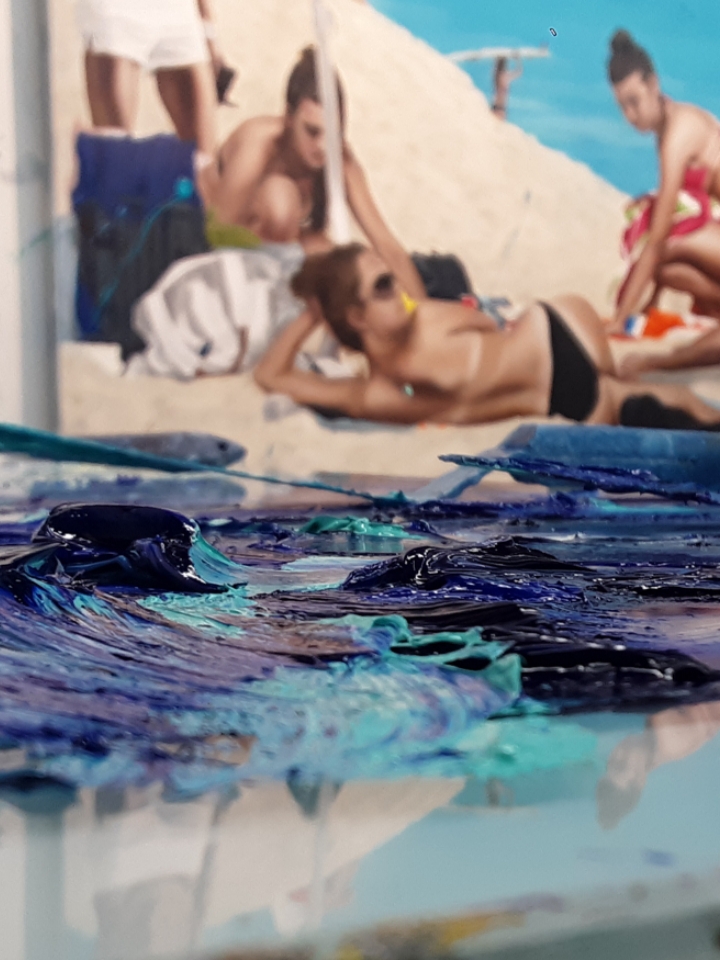
Painting always contains a subtle intensity and reveals physical and psychological connections between ourselves and the world we see around us. The abstractions also have a way of slowing down time, they slow down the process of looking and experiencing the works through their fragmentation and obscuration of the images and reshape these experiences into new configurations that exist only in our contemporary era and are unique to each individual painting. And there’s a dimensionality in painting that is quite sublime, surface variabilities where the paint becomes the subject itself while retaining its illusion. It crosses back and forth between a threshold of reality and illusion, while the artist fills that space with thought and emotion like a vessel. This is why I feel like the dimension of painting is unlike any other media, because in ways it can seem more real and substantial than our own, especially when one is engaging with the process of its creation, revision, and even overpainting.
ARTCOLLECTORNEWS: The title Surfside is geographically straightforward, but the shoreline is also literally an unstable boundary — land and water continually covering and uncovering one another. Do you see that as analogous to what is happening in the paintings, where figuration and abstraction keep overtaking one another?
That’s a really good point. Having grown up near the water, being from Charleston, South Carolina, on the Atlantic Ocean, and then living on an island in the Puget Sound in the Pacific Northwest, later with my adolescence and teen years on the east coast of Florida where we actually lived on the water, and now with most of my summers swimming and surfing at Long Beach, New York, this relationship to both the ocean and these shoreline boundaries between land and water has affected my thinking and my approach to painting in many ways. And yes, it is definitely an unstable boundary, quite similar to that in the paintings, always changing and unpredictable. I’ve always thought of abstraction as taking on aspects of nature, rhythms, and movements of our environment, but this ebb and flow where figuration and abstraction overtake one another seems particularly influenced by the merging of these two worlds.
ARTCOLLECTORNEWS: Finally, if Last Days of Summer and Surfside are two chapters in one continuing investigation, what does Surfside understand about the beach — and perhaps about painting itself — that the earlier work had not yet discovered?
In the Last Days of Summer series, I was approaching this subject with a genuine interest in expanding the narrative content of my paintings within my personal life, as a reflection on leisure, and to see if this content would intermix well with abstraction. In continuing with this subject, an entire world seems to be unfolding to encompass a wider range of human emotions and expressive potential. I am absolutely fascinated with observations of other people, their behaviors, activities, energy and vitality are something that you can immerse yourself in at the beach. And this subject has continued to reveal new facets of emotion and mini dramas that I hadn’t anticipated. What I’ve observed with the Surfside paintings is that the leisurely setting is now a stage for a vast array of subjects, people, and fleeting moments that lend themselves perfectly to painting. And that this backdrop of the ocean, its presence in the studio, and the incredibly cathartic energy and atmosphere of the beach can be transmitted to the viewer as a subject they themselves can relate to from their own surfside experiences, as serious art, portraiture, eroticism, allegory, interpersonal dynamics, and emotional expression.
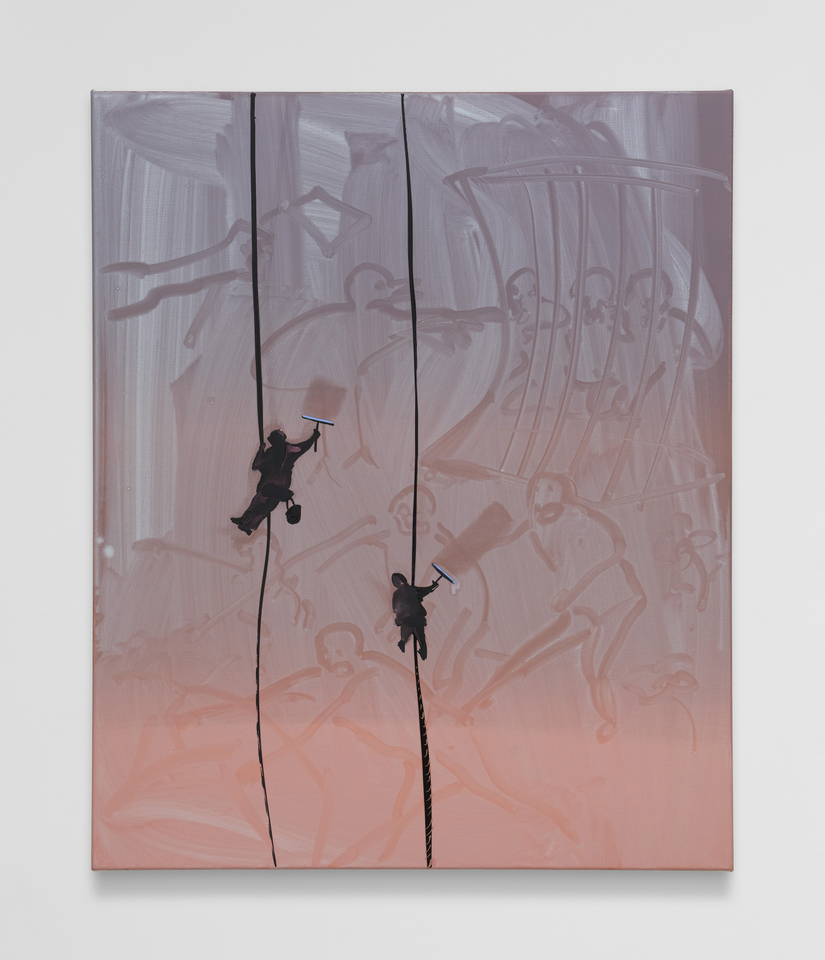
Tala Madani’s new paintings and animations turn cutting, erasure and reconstruction into a language of power. Using fresh artist testimony alongside the exhibition material, we examine why the work is funniest when control starts to fail.
Eight new sculptures turn handmade ceramic beads, soils from three countries and metal stitching into a chorus of maternal forms—an exhibition where repair becomes structure rather than correction.