
August 20, 2026
Articles
Articles
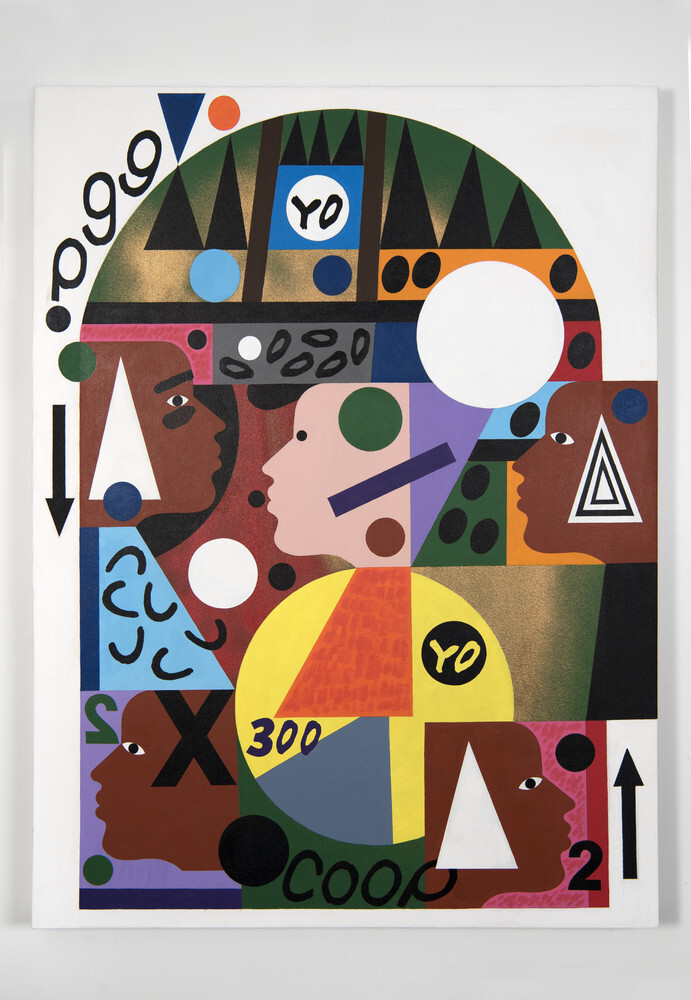
Peggy Cooper Cafritz lost more than 300 works in a devastating 2009 fire. The collection she built afterwards reveals why her legacy was never simply about ownership.
A Nazi-looted painting from Jacques Goudstikker’s collection reportedly survived for years in an Amsterdam cellar after being found in street rubbish. Its return is a lesson in why provenance never expires.
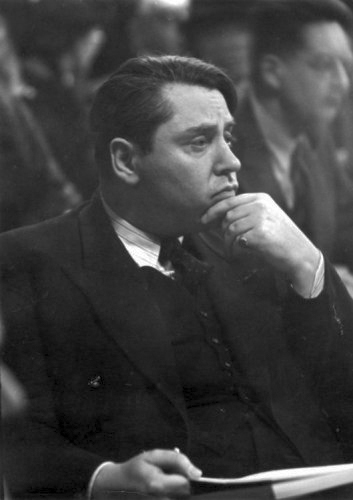
A painting can disappear because somebody hides it. It can also disappear because, eventually, nobody recognises what it is. That is the unsettling beauty of the latest recovery connected to Jacques Goudstikker: a diptych believed by art detective Arthur Brand to be by Hendrick van der Burgh, depicting the interior of Amsterdam’s Nieuwe Kerk, reportedly survived for years in the cellar of a man who had found it among rubbish left on an Amsterdam street.
In July, the work was identified as having belonged to Goudstikker, the Jewish-Dutch Old Master dealer whose stock was dispersed under Nazi occupation after he fled the Netherlands in 1940. The painting is now being returned to his heirs. It is an extraordinary recovery story, but its real significance lies in the opposite direction. How can an object move from one of Europe’s most important art businesses to a rubbish pile while the ownership question remains alive for more than eight decades?
Jacques Goudstikker was one of the leading Old Master dealers in interwar Europe. When Germany invaded the Netherlands, he fled with his wife, Dési, and their young son. He died during the escape, aged 42, after falling through an open hatch aboard the ship carrying the family away from Europe.
What he left behind was enormous. The Monuments Men and Women Foundation records 1,113 inventoried works in the gallery stock, plus hundreds more. The business and collection were subsequently taken over through transactions involving the Nazi-connected banker and dealer Alois Miedl and Hermann Göring. Göring acquired hundreds of works.
Goudstikker also left behind something far smaller: a black notebook containing records of paintings bought and sold. Provenance research often sounds abstract until one sees what it depends on—numbers, names, abbreviated titles, prices, dates, handwriting. The notebook became one of the crucial documentary tools for reconstructing a collection whose physical unity had been violently destroyed.

After the Second World War, many works recovered in Germany were returned to the Netherlands. But return to a state is not the same as restitution to an owner. Goudstikker’s widow pursued the collection after the war; the dispute continued across generations. In 2005 the Dutch Restitutions Committee recommended the return of 202 of the 267 works then claimed from the national collection, and the government implemented the major restitution in 2006.
That milestone was substantial, but it was not an ending. The July 2026 diptych followed another recent recovery: Toon Kelder’s Portrait of a Young Girl, which had reportedly remained with descendants of Dutch SS commander Hendrik Seyffardt. The fact that works can still emerge from family homes, cellars, property listings and accidental discoveries is evidence of how long displacement persists once documentation and objects part company.
There is a comforting assumption that time clarifies ownership. In looted-art cases, time often does the opposite. Witnesses die. Archives scatter. Borders change. Dealers close. Titles are shortened, attributions revised, frames replaced and family stories simplified. An object may look increasingly innocent precisely because its history has become harder to see.
For today’s collector, Goudstikker’s story is not only a history lesson. It is a standard of care. Buying an Old Master is not simply an exercise in connoisseurship. It is an acquisition of a legal and historical biography.
The minimum question—“Does the seller have title?”—is necessary but insufficient. A more serious collector asks how the work moved through the period from 1933 to 1945, whether names in the provenance correspond to persecuted collectors or forced sales, whether the work crossed occupied territories, whether gaps have plausible explanations, and whether catalogue numbers, labels, photographs or archival references connect it to unresolved claims.
This is not a demand that every collector become a wartime historian. It is a demand that uncertainty be treated as information. A blank decade in provenance is not neutral. Neither is a phrase such as “private collection, Europe” when it conceals rather than clarifies the chain of custody. Where questions arise, specialist provenance researchers, archives and relevant loss and restitution databases should be part of the acquisition process before funds move.
Collectors sometimes imagine provenance disputes as accusations of personal wrongdoing: if the present owner did not steal the work, why should the present owner suffer? That framing misses the structure of the problem. Restitution is usually about whether ownership was lawfully extinguished in the past, not whether the current possessor is morally equivalent to the original wrongdoer.
Legal outcomes differ by jurisdiction, limitation rules, good-faith purchase doctrines and the specific facts of each case. The ethical question can be clearer. If credible evidence shows that an object entered the market through persecution, coercion or theft, possession has not magically converted that history into legitimacy. The current owner may be innocent of the original act and still hold the key to repairing it.
This is where collectors have unusual power. Museums operate under public scrutiny and formal policies. Private owners can be harder to reach. A painting behind a domestic door can remain outside scholarly view for decades. The private collector can therefore be either the last obstacle in a provenance chain or the person who reconnects the object to it.

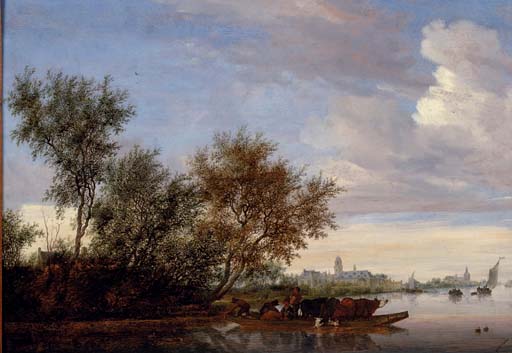
A work such as Salomon van Ruysdael’s Ferry Boat with cattle on the River Vecht near Nijenrode demonstrates how much history can be compressed into a provenance line. The painting has been recorded in the Goudstikker collection, the Göring collection, postwar Dutch custody and later the collection of the Goudstikker heirs. Those names are not decorative catalogue information. They describe a route through private taste, state violence, recovery, administrative failure and restitution.
Once seen that way, provenance ceases to be the dull section under the glamorous image. It becomes the most human part of the catalogue entry.
The July recovery is almost too symbolically precise. A work once connected to a great dealer, then displaced through the machinery of Nazi looting, survives unnoticed in a cellar because someone could not bring himself to let it be thrown away. Its material survival depended not on expertise but on hesitation.
Then expertise returned. A news story about another restitution prompted recognition; recognition prompted research; research reconnected the object to a name. This is how provenance works at its best: as a chain of attention.
The lesson for collectors is not that every attic contains a masterpiece. It is that every artwork carries more than its visible surface, and that ownership confers obligations as well as privileges. The question “What is it?” should always be followed by “Where has it been?” and, when the history demands it, “Whose is it?”
Goudstikker’s collection was scattered in months. Its reconstruction has taken generations. That imbalance should permanently change the way we think about due diligence. A sale can transfer an object in an afternoon; repairing a broken provenance can take eighty years.
Reporting status: 19 August 2026. The attribution of the recovered Nieuwe Kerk diptych has been reported as likely Hendrick van der Burgh; the wording should be updated if subsequent scholarship changes that attribution.
Peggy Cooper Cafritz lost more than 300 works in a devastating 2009 fire. The collection she built afterwards reveals why her legacy was never simply about ownership.
A Nazi-looted painting from Jacques Goudstikker’s collection reportedly survived for years in an Amsterdam cellar after being found in street rubbish. Its return is a lesson in why provenance never expires.
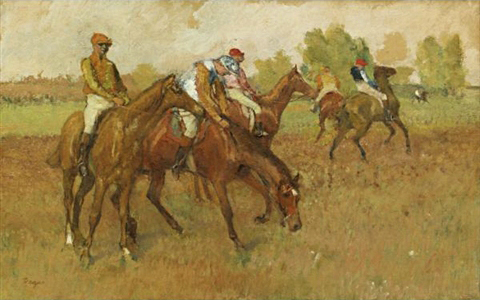
A reported $450 million Blaquier consignment at Sotheby’s is more than a trophy sale: it is a test of how privacy, provenance, guarantees and collection identity create value.