
September 8, 2026
Articles
Articles
The Bayeux Tapestry opens at the British Museum after returning to England for the first time in nearly 1,000 years. Beyond 1066, it is a lesson in material, narrative and conservation.
The Bayeux Tapestry opens at the British Museum after returning to England for the first time in nearly 1,000 years. Beyond 1066, it is a lesson in material, narrative and conservation.
The Bayeux Tapestry opens at the British Museum on 10 September after returning to England for the first time since it was made nearly a millennium ago. The historic loan is already a public phenomenon, but collectors should look beyond 1066: this is also an exhibition about material survival, sequential image-making and the extraordinary power of one object to function simultaneously as art, record and political narrative.
Calling the Bayeux Tapestry a tapestry has always been slightly misleading. It is an embroidery: wool thread worked on linen, roughly 70 metres long, created in the eleventh century. The British Museum describes it through 58 scenes, 626 human figures and 202 horses. Its subject is even larger—the events leading to William, Duke of Normandy’s conquest of England in 1066, culminating in the Battle of Hastings and the death of King Harold II.
From 10 September 2026 until July 2027, the work is being shown in the British Museum’s Sainsbury Exhibitions Gallery. The loan from France is historic both symbolically and materially. The museum says it is the first time the object has been in the United Kingdom since it was made almost 1,000 years ago. In exchange, British Museum treasures including material from Sutton Hoo and the Lewis chess pieces will travel to Normandy before the tapestry returns for the reopening of the Bayeux Museum.
Demand has been extraordinary. Reuters reported on 7 September that advance sales had generated about £2.5 million, making it the British Museum’s highest-grossing exhibition by that measure before public opening. The popularity is understandable. Few works of art occupy such a large place in national memory.
The temptation is to read the tapestry for information: Harold, William, ships, horses, battle, conquest. But before it becomes history, it is an object. Linen had to survive. Wool pigments had to remain legible. Seams, repairs and the cumulative physical stress of nearly a millennium form part of what visitors will actually encounter.
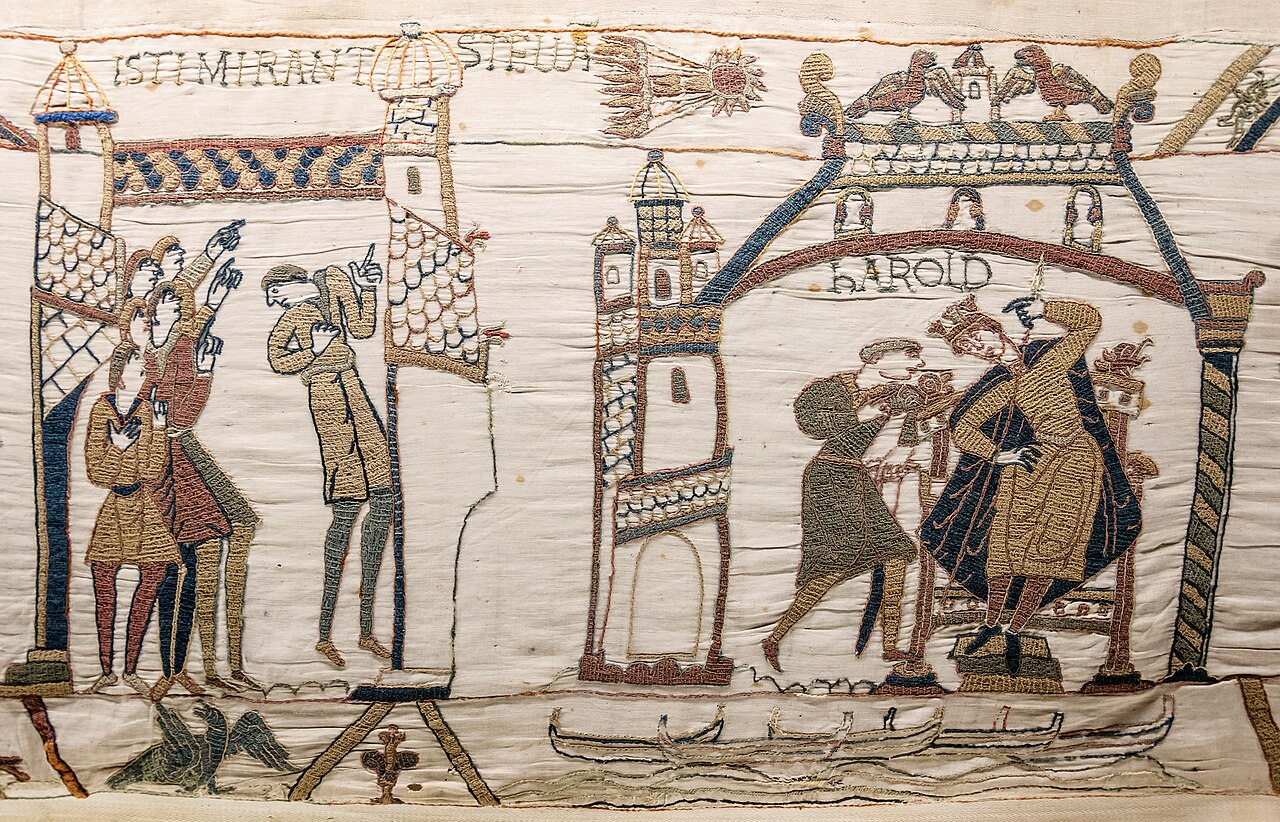
This is one reason seeing the original matters. Reproductions are excellent at transferring image content and poor at transferring material scale. A textbook can show Halley’s Comet. It cannot make a viewer walk beside a narrative that extends for approximately 70 metres.
For collectors, the lesson is familiar but important: scale and material are not supplementary facts. They are part of meaning. A digital image may tell you what an object depicts while hiding what the object asks the body to do.
The Bayeux Tapestry is frequently approached as evidence for medieval history, but its sophistication as a visual narrative deserves equal weight. Action unfolds horizontally. Figures repeat. Architectural forms signal changes of place. Borders contain animals, symbols and secondary imagery. Latin inscriptions guide but do not fully control interpretation.
.jpeg)
Ships are especially effective because movement across water naturally advances the story. The embroidered line does not need Renaissance perspective to create momentum. Boats, oars, bodies and repeated directional forms lead the eye.
Seen from the twenty-first century, the work can be understood alongside later sequential forms—from illustrated manuscripts to comics and film storyboards—without pretending those media are identical. What connects them is the problem of making time visible inside a sequence of images.
The Bayeux Tapestry does not merely depict history. It engineers the order in which history is seen.
The British Museum describes the embroidery as likely commissioned by a Norman patron and made by English embroiderers, drawing on manuscript traditions associated with Canterbury. That mixed origin is one reason its status as a historical “record” needs care.
The tapestry is extraordinarily informative. It shows forms of architecture, weapons, armour, ships, clothing, furniture and food. But information is not neutrality. The story has a point of view. Choices are made about which scenes matter, how protagonists appear and how causality is presented.
Collectors of politically or historically charged material know this problem well. An object can be authentic evidence of its time while presenting a highly interested account of that time. The task is not to choose between “art” and “document”, but to read both functions simultaneously.
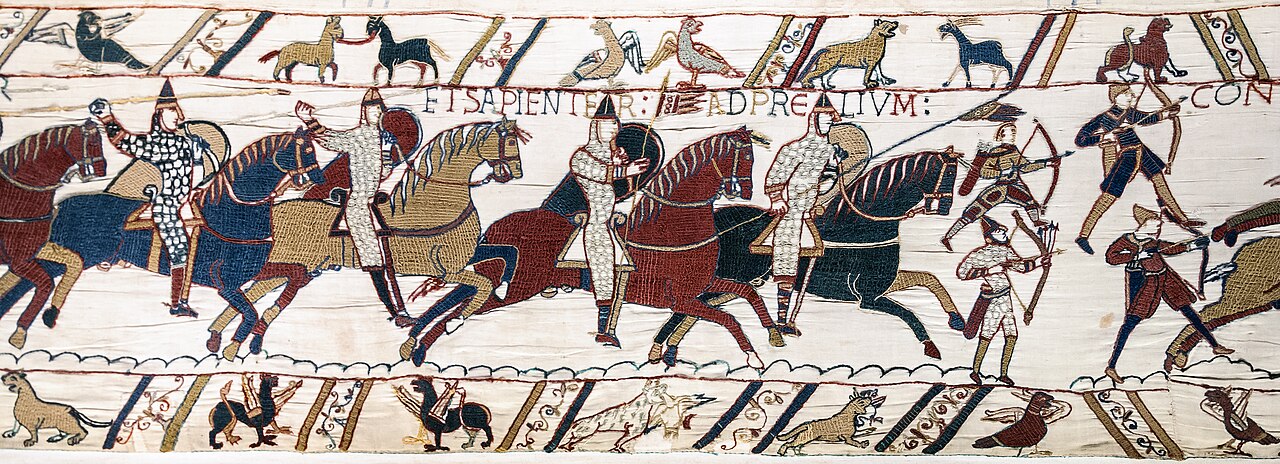
The Battle of Hastings scenes show how effectively the embroiderers converted violence into rhythm.
Horses repeat at angles. Spears create directional lines. Shields become graphic punctuation. Bodies collapse into the lower border. The image communicates confusion while remaining legible enough for the narrative to continue.
This balance between order and disorder is central to battle imagery across art history. Too much order and violence becomes decorative; too little and the story becomes unreadable. The Bayeux designers solve the problem with repetition.
For a modern collector accustomed to thinking about composition in painting, the tapestry is an opportunity to see the same visual questions solved through thread.
The journey from Bayeux to London required careful planning because the significance of the loan is matched by the vulnerability of the object. Textile conservators must manage support, light, environmental conditions and the physical stresses created by display and transport.
The conservation dimension should change how the public understands the exhibition. This is not simply a blockbuster loan of a famous “image”. It is a temporary movement of one exceptionally old material object whose continued survival depends on restraint.
That principle applies to private collections too. Works on textile, paper and other light-sensitive supports can require display schedules that conflict with the desire to see them constantly. Responsible ownership sometimes means accepting periods of darkness.
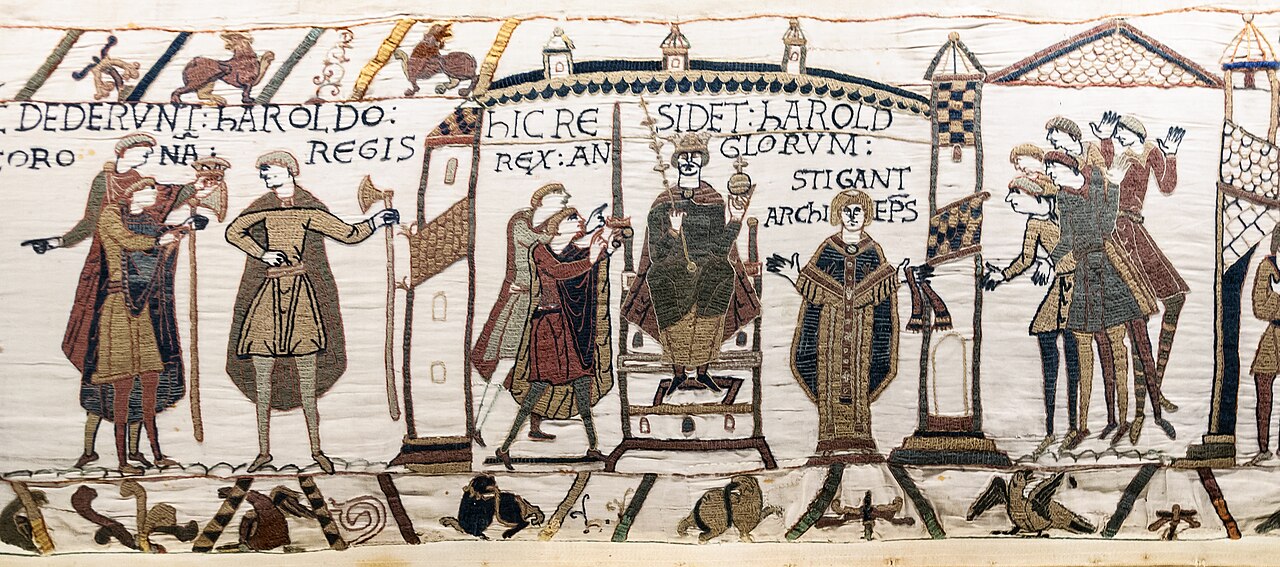
The final battle sequence contains one of the tapestry’s most famous episodes: the death of Harold.
.jpeg)
The scene has generated scholarly debate over exactly which figure represents Harold and how the famous arrow-in-the-eye interpretation developed. That uncertainty is valuable. It reminds visitors that canonical images can accumulate interpretations that feel more fixed than the object itself.
Collectors encounter similar problems in attribution, dating and iconography. The label is not always the end of inquiry. Sometimes the most responsible reading is to preserve ambiguity.
The Anglo-French agreement also deserves attention as a model of cultural exchange. British Museum objects representing all four nations of the UK are travelling to Normandy while the Bayeux Museum undergoes redevelopment. The tapestry will return to France in time for the museum’s reopening.
This reciprocity gives the loan more substance than a simple prestige event. Objects move, audiences change and each institution temporarily allows another public to see material normally bound to place.
For collectors who lend to museums, the principle is familiar. A loan can create scholarship, expose a work to new comparisons and widen access without requiring permanent transfer of ownership.
The Bayeux Tapestry will attract many visitors because they know the story. The opportunity is to leave understanding the object differently.
Look at the colour choices. Look at the different hands implied by the embroidery. Look at the borders. Notice how architecture compresses space, how a horse’s direction moves the narrative, how repeated shields make rhythm, how material condition changes what can still be read.
Nearly a millennium of fame can make an object seem exhausted by interpretation. The opposite is true here. The closer one gets, the less the tapestry looks like a single historical illustration and the more it becomes a complex collected object: commissioned, made by many hands, preserved, moved, argued over and repeatedly re-read.
The Bayeux Tapestry is an extreme example of a problem that affects all canonical art. Once an object becomes familiar through reproduction, viewers begin to substitute recognition for observation. They see “the Bayeux Tapestry” before they see this section of linen, this colour, this seam or this repair. The exhibition is a rare opportunity to reverse that process.
Collectors can apply the same discipline to famous artists and familiar images. Stand close enough to notice material condition; then step back far enough to understand scale. Compare what the catalogue told you with what the object actually does. Ask which details only become visible in person. Reputation is useful context, but it should never be allowed to perform the act of looking on the viewer’s behalf. The more famous the work, the more consciously that habit may need to be resisted.
That is why its return to England matters. The spectacle is the loan. The deeper experience is discovering how much of the object could never fit into the schoolbook image in the first place.
The Bayeux Tapestry opens at the British Museum after returning to England for the first time in nearly 1,000 years. Beyond 1066, it is a lesson in material, narrative and conservation.

Pierre Chapo’s elm furniture has moved from connoisseur design into the art collector’s field of vision. The reason is not fashion alone: his best pieces make construction itself the subject.
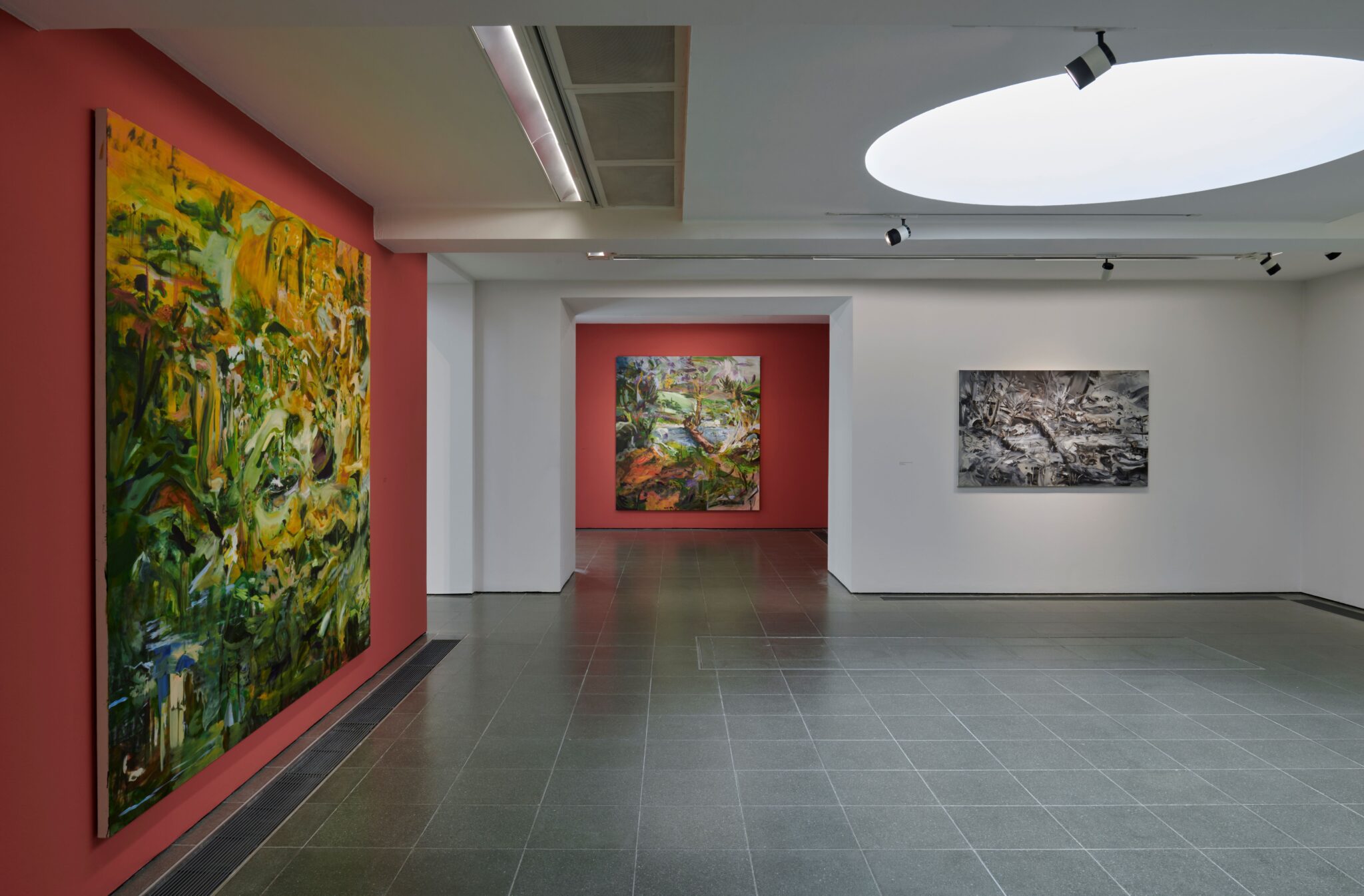
Cecily Brown’s Picture Making turns uncertainty into a painterly method: figures emerge, dissolve and return across twenty-five years of paintings, drawings and monotypes.